Canadians' online behaviour can put them at moderate to high risk of cyber attacks: RBC Cyber Safety Index
Using public Wi-Fi, reusing passwords, and providing personal information are the top three risks Canadians take online Despite...

2-10- RBC Cyber Safety Index
In this article4 sections
Using public Wi-Fi, reusing passwords, and providing personal information are the top three risks Canadians take online
Despite awareness of cyber best practices, many Canadians are still putting themselves at risk online, according to a new RBC survey, which found that two-in-five Canadians (38%) qualify as moderate to high-risk potential for becoming victims of cyber-attacks.
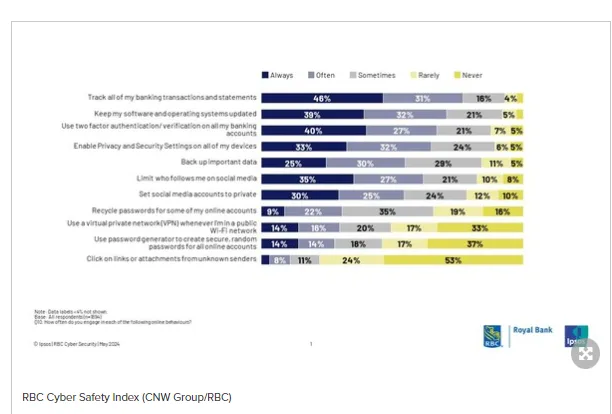
RBC’s new Cyber Safety Index reviewed how often Canadians engage in certain behaviours online. While the majority practice at least some good cyber hygiene, less than half say they always use all of the recommended online safety behaviours, which include keeping their software and operating systems updated (71%), using two-factor authentication/verification on online banking accounts (67%), enabling privacy and security settings on all devices (65%) and limiting who follows them on social media (63%). Less than a third (30%) always or often use virtual private networks (VPN) when surfing public Wi-Fi; or password generators to create secure, random passwords for online accounts (28%), leaving considerable room to improve across the board.
“The responses to our Cyber Safety Index show that while many Canadians are aware of things they can do to be safer online, there’s still opportunities for them to change behaviours and close that risk gap,” said Adam Evans, chief information security officer at RBC. “At RBC, we’re focused on providing Canadians with the practical tips and education they need to take control of their online safety and mitigate risks in an ever-evolving digital world.”
Canadians still taking cyber risks
On the flip side, many Canadians are also participating in risky online activities that could further increase the potential of exposure to cyber-attacks. Within the past year, over three-quarters (77%) have knowingly or accidentally engaged in at least one risky online behaviour, with the most commonly reported being using public Wi-Fi (49%). Others include consenting to share their personal information when asked (27%), clicking on pop-up ads (19%), visiting unsecure websites (18%) and ignoring privacy settings on social media platforms (13%).
Furthermore, over a third (35%) agree they have used the same password(s) across multiple platforms, and nearly as many are more concerned about missing out on exclusive events/activities than disclosing personal information online (32%), and/or have interacted with unsolicited texts or social media messages (31%).
Top safety concerns
Despite these results, the vast majority of Canadians said they are concerned about being victimized by online fraud (80%), identity theft (84%), corporate data breaches (79%), being hacked (84%), and/or experiencing unauthorized access to their online accounts (87%), in line with last year. However, significantly fewer feel safe engaging in social media activities (69%; -7 pts) compared to 2023.
Fortunately, a growing proportion of Canadians (85%; +3 points) say they are comfortable learning new ways to protect their online information compared to last year, underscoring the importance of ongoing education and support to help them navigate the digital landscape safely and effectively.
RBC has articles and guides for Canadians on its Be Cyber Aware website, including the following tips:
- Limit the information you share on social platforms. Don’t accept friend requests from people you don’t know, and even if the privacy settings on your accounts are enabled, try to limit what you share online to avoid scams like spear-phishing.
- Keep your financial information safe. Never log in to online banking using a link sent through email, text message, or social media. Instead, type the address into your browser. Clear your browser’s memory cache regularly to improve security.
- Be vigilant when shopping online. Look for the little padlock icon to the left of the URL bar and ensure the website you’re visiting has an address that begins with “https.” Read reviews before you buy to ensure they’re legitimate and trustworthy businesses.
- Create long, strong passwords. Always use the maximum password length allowed and aim for at least 16 characters. Longer is better, like “passphrases” made of randomly chosen words, that can be easy to remember and hard for someone else to guess.
To learn more, visit rbc.com/cyber.
About the RBC Study
These are the findings of an Ipsos poll conducted on behalf of RBC. The survey was conducted in English and French. A sample of 1,894 Canadians over 18 was surveyed online via the Ipsos I-Say panel from May 3 to 7, 2024.
About RBC
Royal Bank of Canada is a global financial institution with a purpose-driven, principles-led approach to delivering leading performance. Our success comes from the 100,000+ employees who leverage their imaginations and insights to bring our vision, values and strategy to life so we can help our clients thrive and communities prosper. As Canada’s biggest bank and one of the largest in the world, based on market capitalization, we have a diversified business model with a focus on innovation and providing exceptional experiences to our more than 18 million clients in Canada, the U.S. and 27 other countries. Learn more at rbc.com.
We are proud to support a broad range of community initiatives through donations, community investments and employee volunteer activities. See how at rbc.com/peopleandplanet.
With an aim to contribute to the development of Canada’s Small and Medium Enterprises (SME’s), Cmarketing Inc is a potential marketing agency and a boutique business management company progressing rapidly in its scope. By acknowledging a firm reliance of the Canadian economy over its SMEs, the agency has resolved to launch a magazine, the pure focus of which will be the furtherance of Canadian SMEs, and to assist their progress with the scheduled token of enlightenment via the magazine’s pertinent content.
View profile →