First-of-its-Kind “Smart Paint” by Atlantic Canada Start-up is Making Waves for its Ability to Protect Ships from Corrosion, Biofouling
Copsys Technologies taps into expertise of local students to help develop intelligent tech that enables boats to pre-emptively...


download (1)
Copsys Technologies taps into expertise of local students to help develop intelligent tech that enables boats to pre-emptively “feel” and repair marine damage
Not only is the Strait of Hormuz conflict disrupting global trade, but it’s also causing a less publicized issue: accelerated degradation and biofouling of hundreds of cargo ships waiting to pass through the Persian Gulf region.
These delays create two distinct risks for ship operators. Ships on extended deployments are susceptible to accelerated corrosion damage when maintenance cycles are disrupted, while vessels left idle in stagnant water can rapidly accumulate heavy marine growth on their hulls and other submerged surfaces.
The risks extend beyond ship maintenance to global marine biosecurity. As affected vessels resume voyages through the Strait of Hormuz and onward to international destinations, organisms attached to their fouled hulls could be transported to ports and coastlines worldwide. Without effective biofouling management, these vessels risk introducing invasive marine species that can disrupt native ecosystems and damage fisheries, potentially turning a regional shipping disruption into a lasting global environmental threat.
Thanks to a breakthrough invention by an Atlantic Canadian tech start-up, this phenomenon may soon be a thing of the past. Copsys Technologies – based in St. John’s and Halifax – has developed a first-of-its-kind eco-friendly smart coating for ships, called the Copsys Intelligent Digital Skin, that can “feel” and automatically prevent early marine damage.
“Our goal is to transform the way critical infrastructure is protected,” said Mike Maguire, President and CEO of Copsys Technologies, which was launched in 2020.

“Five tons of steel are lost to rust every single second, costing the global economy about US$2.5 trillion each year and creating a major problem for ship operators and navies,” Maguire said. “Beyond the financial toll, sidelining navy defense vessels for maintenance compromises mission readiness. We need to either build more ships, so we have enough ready to go or to make them more resilient so they not only last decades longer but are available when needed, which is what we’re doing.”
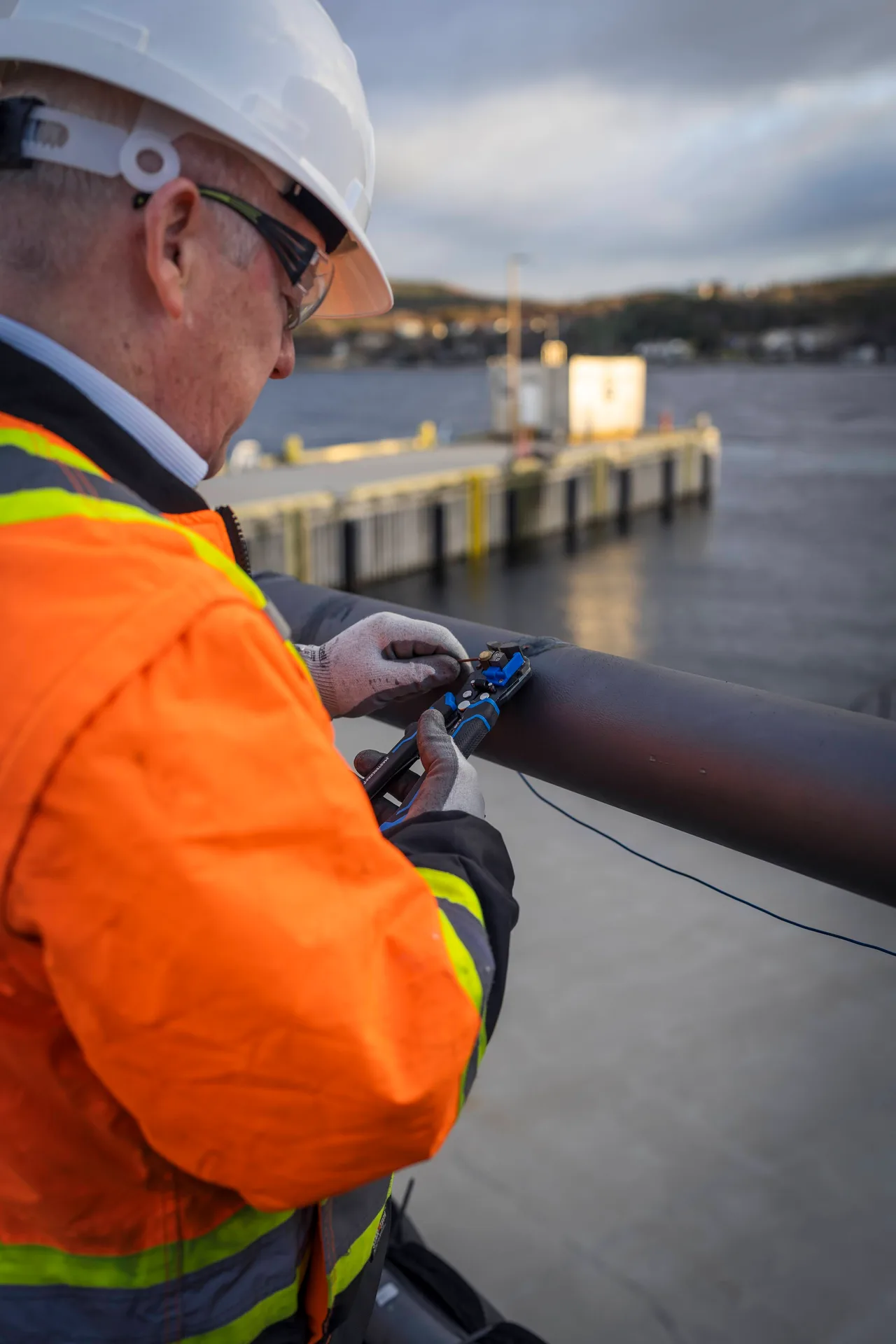
The Copsys Intelligent Digital Skin is the first non-toxic coated surface that reacts on demand with seawater to keep ship hulls clean, stopping marine growth before it starts. If the metal beneath is exposed to a corrosive environment, the system – an Internet of Things (IoT) solution – detects the breach, pinpoints its location, and deploys an electrochemical barrier to prevent corrosion. At the same time, the condition of the ship can be remotely monitored in real time on a digital twin.
“It’s the first true disruption of impressed current cathodic protection (electrical rust prevention) since the Industrial Revolution, and it’s done through a paint,” said Maguire. “We don’t detect corrosion – we actually detect exposure to corrosion, and we neutralize the threat all at the same time.”
Local students helping to advance research
To help advance the technology, Copsys Technologies turned to the skills of post-secondary and graduate students at Memorial University of Newfoundland in St. John’s and Dalhousie University in Halifax through an internship program by Mitacs, a national not-for-profit organization that connects businesses with access to highly skilled talent, financial support, and the partnerships needed to turn ideas into impactful innovations.
“Mitacs opened opportunities for us to engage and develop a pipeline of highly qualified technical talent and collaborate with academic partners at universities to help advance our work,” Maguire said.
“Small technology startups like ours don’t have huge research facilities of our own, so if we can leverage collaboration with Canadian universities to assist with innovation, particularly when it comes to validating our technology, it helps everybody,” he said, explaining that not only does his company benefit, but students also gain practical experience at the cutting edge of technology that boosts their skills, confidence and future job prospects.
“Partnerships like this collaboration with Copsys demonstrate what can be achieved when we invest in forward-thinking ideas and connect industry with top-tier, emerging talent,” said Dr. Stephen Lucas, Mitacs CEO. “Mitacs is proud to be part of the Copsys story. It’s a great example of how research-driven innovation can strengthen local economies and contribute to Canada’s long-term growth and competitiveness, and defence and security.”
Kousha Kashani, who completed his Master of Engineering under a Mitacs internship with Copsys last year, is now pursuing a PhD in Mechanical Engineering at Dalhousie University under the company’s sponsorship. Maguire expects this will position him as a valuable recruit for the company.
“Through Mitacs internships, I’ve had the opportunity to work with Copsys and see my research used directly in production – something I’ve always hoped to experience. I’m grateful for that opportunity and for the wonderful people who have shared their knowledge along the way. What I’m learning from them continues to shape both my work and the direction I want to take,” said Kashani, whose work with Copsys included mechanical and electrochemical performance testing of the intelligent digital skin and validating numerical models to verify the accuracy of the technology.
To date, the intelligent digital skin coating has been tested and validated on insulated pipes by UK and Norwegian North Sea industry partners – including at a coastal natural gas liquification terminal and on board a floating production facility, with a subsequent pilot demonstration planned for a natural gas compression and export platform by the end of the year.
With industrial pilot tests nearing completion, the intelligent digital skin technology is expected to be commercially launched in early 2027, with ship hull applications to follow shortly after, Maguire said.
“Metal pipes and ship hulls have the same issue,” he explained. “In industry, corrosion under insulation is a big problem, responsible for about 20% of serious industry process safety incidents. Currently, organizations must strip off the insulation to see the problem, but our digital skin technology monitors that surface without anyone having to expose it.”
This real-time capability integrates seamlessly across NATO shared networks, Maguire said. In fact, the company received validation from NATO earlier this year when Copsys was selected as one of 150 innovator companies from more than 3,600 applicants for the prestigious NATO DIANA 2026 Challenge Programme Cohort.
The NATO DIANA program connects companies with defense end-users, mentors, and investors to accelerate the development, validation, and adoption of their innovations to help NATO tackle urgent operational challenges and maintain a decisive edge in defense technology.
“There’s no other technology on the planet that could tell you definitively the condition of protective coatings under layers of cladding and insulation at any given time until ours came along,” Maguire said. “Our invention is on track to redefine how the world protects its most critical marine infrastructure.”
About Mitacs
Mitacs delivers the return on innovation Canada needs now by connecting big ideas, people, and ambition to turn potential into results. Through our co-funded innovation partnerships, we get Canada’s businesses and researchers where they need to go. Mitacs partners innovate faster. Commercialize sooner. Compete globally. Scale and grow stronger. We open the door to opportunity, creating jobs and equipping students and postdoctoral researchers with skills, industry experience, and professional networks. A national not-for-profit organization founded in 1999, Mitacs is funded by the Government of Canada, the Government of Alberta, the Government of British Columbia, Research Manitoba, the Government of New Brunswick, the Government of Newfoundland and Labrador, the Government of Nova Scotia, the Government of Ontario, Innovation PEI, the Government of Quebec, the Government of Saskatchewan, and the Government of Yukon.
Source : Mitacs
With an aim to contribute to the development of Canada’s Small and Medium Enterprises (SME’s), Cmarketing Inc is a potential marketing agency and a boutique business management company progressing rapidly in its scope. By acknowledging a firm reliance of the Canadian economy over its SMEs, the agency has resolved to launch a magazine, the pure focus of which will be the furtherance of Canadian SMEs, and to assist their progress with the scheduled token of enlightenment via the magazine’s pertinent content.
View profile →