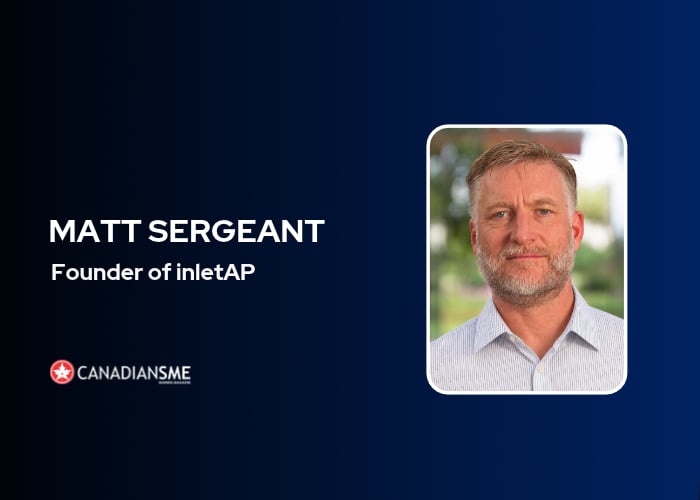
From Hubdoc to inletAP: Matt Sergeant on Simplifying Accounts Payable
In this exclusive feature, Matt Sergeant, Founder of inletAP, shares how he is transforming accounts payable for property...

download
- Matt Sergeant says property managers juggle many buildings and owners, so AP software built for one set of books doesn't fit their needs.
- inletAP checks each bill against that vendor's past billing at that property, plus approval limits and existing invoices, to catch errors and duplicates.
- Pricing is published, with a free plan for 25 invoices a month, paid plans from $39 to $249, and unlimited users on every plan.
In this article5 sections
In this exclusive feature, Matt Sergeant, Founder of inletAP, shares how he is transforming accounts payable for property management companies through AI, automation, and smarter financial workflows. Based in Toronto, Canada, Matt was previously the founding engineer at Hubdoc, a document-capture company acquired by Xero. He also created Haraka, an open-source email server, bringing extensive technical expertise to building practical solutions for small businesses.
Through inletAP, Matt is simplifying invoice processing with intelligent data extraction, duplicate bill detection, vendor price verification, automated approvals, and QuickBooks Online and Xero integrations. With transparent pricing, unlimited users on every plan, and a free plan, inletAP stands out by making accounts payable automation more accessible. Its recent innovations, including two-way purchase order matching across all plans, reflect Matt’s mission to reduce manual paperwork, prevent costly invoice errors, and help property managers and bookkeepers work more efficiently.
What did building Hubdoc teach you about small-business paperwork, and how did those lessons shape inletAP?
When we started Hubdoc it was a consumer product, fetching bills from utilities, banks and vendors. We designed it to be a better version of Canada Post’s EPost service (since discontinued). We quickly had to pivot to being a product for bookkeepers, as that was the cohort willing to pay, and consumer products are really hard.
One of the main things I learned was that if you can be organized for people, rather than relying on them to organize things, it’s a huge win for everyone. Doing the organizing for them, rather than giving them the flexibility to do it themselves, saves them time.
Aside from organization, one of our biggest features was ingestion (hence the name inletAP). Our users liked two ways of getting documents in: mobile or email. Nobody sitting at a desktop wants to save a document, switch to another website, find it again and upload it to a different service. Email just fit the bill.
So inletAP does both. Vendors email each building’s own address, and the organizing is done for you: which property, which account, who approves it, and whether the amount is right.
Why is accounts payable still so manual for property managers, and where can automation make the biggest difference?
Because most AP software assumes you’re one company with one set of books. A property manager isn’t. They’ve got forty buildings and a dozen owners, each with their own books.
So every bill has to be coded to the right property, sometimes split across three of them, and then approved by a site manager who doesn’t work in accounting (and doesn’t want to). In a lot of companies that still means someone reading a PDF, typing it into QuickBooks, and chasing an approval by email.
Automation helps in three places. Reading the invoice, with a confidence score on every field, so you check the uncertain values instead of retyping the whole thing. Routing it to the right approver by amount and by building.
And the one almost nobody does: checking whether the bill is actually right before you pay it.
That last one is where the money is.
What invoice mistakes do businesses commonly miss, and how can comparing bills by vendor and property help catch them?
A landscaper who’s billed $1,240 a month for two years sends a bill for $1,460. Or a second invoice for the same job turns up a week after the first, by a different route. Or a bill lands at $4,950 when the site manager can approve up to $5,000 on their own.
Each of those is obvious once you compare it with the right history. The catch is that “the right history” means that vendor at that building. The same landscaper can be on a fixed contract at one property and time and materials at the next, so if you average them across the portfolio you hide exactly the change you’re looking for.
So that’s what inletAP does with every bill. It compares it with what that vendor billed that property before, with the approval limits you’ve already set, and with every invoice you already have from them. Then it tells you what it found, on the invoice you were already looking at.
It doesn’t block anything or email the vendor. The one exception is a likely duplicate, which can’t be exported until a person has looked at it.
Why did you choose published pricing, unlimited users, and no sales calls instead of a traditional software sales model?
Because the people I’m building for are small teams, and a sales process costs them twice. Once in the hour they spend on a demo, and again in a price that has to pay for the salesperson.
So the prices are on the website. It’s free for 25 invoices a month, then $39 to $249. You can see that without talking to me (although I’m happy to talk).
Per-user pricing is the bigger question. When AI is doing a ton of the work for you, paying per person stops making sense. We’re in that world now, and busy property managers are just starting to catch up to it. So we priced for where it’s going: you pay per invoice, and every plan has unlimited users.
It matters even more in property management, because most of your users are approvers: site managers and owners who log in a few times a month. Charge per seat and companies start rationing who’s allowed to approve things.
And the free plan doesn’t run out. Forward a month of your real invoices and judge it on your own bills.
What has building inletAP as a solo founder taught you about creating software that small businesses actually need?
I hang out in a bunch of forums where solo founders chat. Everyone runs into the same thing: distribution. Building the product is the easy bit. Getting it in front of the right people is the hard part. That and loneliness – I’ve always worked in companies with a CEO, a COO, a product manager of some form, and other developers. It’s not a path for everyone.
The other thing is that small businesses don’t want more features. They want the one check that catches the expensive mistake, and they want it to work without a setup project. It’s the Hubdoc lesson again: organize it for them. So the bill checks run from the first invoice with nothing to configure.
Being solo also means I build in the order customers actually need things, not the order I’d enjoy. Pulling bills straight from utility websites (which is where Hubdoc started), vendor payments, and connecting to property management systems are all on the roadmap, and the first customers who need each one will decide what comes first. The iPhone app is coming in October 2026, so site managers can photograph and approve bills from their phone.
Disclaimer:
The views and opinions expressed in this interview are those of the interviewee and do not necessarily reflect the official policy or position of CanadianSME Small Business Magazine. Our platform is dedicated to fostering dialogue and sharing insights that inspire and empower small and medium-sized businesses across Canada.
With an aim to contribute to the development of Canada’s Small and Medium Enterprises (SME’s), Cmarketing Inc is a potential marketing agency and a boutique business management company progressing rapidly in its scope. By acknowledging a firm reliance of the Canadian economy over its SMEs, the agency has resolved to launch a magazine, the pure focus of which will be the furtherance of Canadian SMEs, and to assist their progress with the scheduled token of enlightenment via the magazine’s pertinent content.
View profile →