How Generative Engine Optimization Is Changing How Small Law Firms Get Found

AI answer engines are changing how clients search for a lawyer — here’s what small and solo firms can do about it
For years, “getting found online” meant one thing for a small law firm: rank on the first page of Google. That’s no longer the whole picture. A growing share of people now ask ChatGPT, Perplexity, Claude, or Google’s AI Overviews a direct question — “who’s a good family lawyer in my city” — and get a short, synthesized answer with two or three names in it, not a page of blue links to sort through themselves.
For a solo or small firm, that shift is either a threat or an opportunity, depending entirely on whether anyone’s paying attention to it yet. Most aren’t. That makes right now a good time to start.
What Generative Engine Optimization actually means
Generative Engine Optimization, or GEO, is the practice of getting a business cited inside an AI-generated answer rather than just ranked on a search results page. It builds on top of traditional SEO rather than replacing it — a fast, well-structured, crawlable website is still the foundation everything else sits on. But AI engines weigh some things differently than Google’s classic ranking algorithm does, and understanding that difference matters.
A few things AI engines tend to reward that traditional SEO doesn’t emphasize as heavily:
- Direct answers, stated plainly. AI engines pull disproportionately from the first few sentences of a section, so content that states the answer to a likely question up front — then explains — gets cited more often than content that builds up to a conclusion gradually.
- Structured data. Schema markup (the behind-the-scenes code that tells search engines “this is a business, here’s its name, address, and services”) helps AI engines recognize a business as a real, categorized entity rather than just text on a page.
- Third-party validation. AI engines cross-reference multiple sources before answering, so consistent information across a business’s website, Google Business Profile, and relevant directories carries real weight. So does genuine discussion elsewhere — several AI engines pull heavily from Reddit threads and similar community discussion when forming an answer, provided the conversation is substantive rather than promotional.
Why this matters more for small and solo firms
Larger firms have historically won the SEO game by outspending everyone else — bigger content budgets, more backlinks, years of accumulated domain authority. That advantage doesn’t disappear with GEO, but it’s less absolute. An AI engine forming an answer to “who handles family law disputes in [smaller city]” isn’t ranking a thousand competing pages against a fixed set of keywords; it’s synthesizing an answer from whatever credible, well-structured, locally relevant information it can find. A properly set up small firm with genuinely useful content has a real shot at being part of that answer in a way that used to require years of SEO investment to achieve through traditional rankings alone.
Practical starting points
A few things any small firm can do without a large budget:
- Fill out Google Business Profile completely — category, services, service area, photos, and a real business description. Incomplete profiles are one of the most common reasons smaller firms lose visibility to competitors who simply did the basics.
- Keep your business name, address, and phone number identical everywhere they appear — website, directories, social profiles. AI engines and Google both use this consistency as a trust signal.
- Write FAQ-style content that answers real client questions directly in the first sentence or two, rather than burying the answer in the third paragraph.
- Participate genuinely in relevant online communities. This isn’t about self-promotion — it’s about being part of real, helpful conversation in spaces AI engines already pull from.
- Treat structured data as part of the content, not an afterthought. If a developer or agency is building or updating a website, ask specifically whether schema markup is included.
None of this requires abandoning traditional SEO — it requires extending it. The firms that will be easiest for prospective clients to find over the next few years, whether they’re typing into Google or asking an AI assistant a question out loud, are the ones treating both as the same underlying discipline: be a real, well-documented, consistently-represented business, and make it easy for any system — human or AI — to understand exactly what you do and where.
About Author
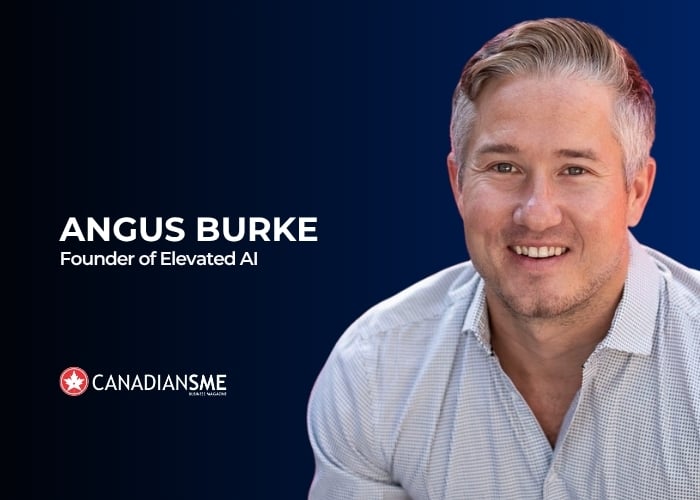
Angus Burke is the founder of Elevated AI, a marketing agency built for solo and small law firms across British Columbia, offering AI-powered SEO, content, and website support scoped for firms too small for a big agency but too busy to handle marketing themselves. Based in Whistler, BC, Angus works with law firms throughout the Sea to Sky corridor and Vancouver, and holds a BSc from Towson University.
Angus Burke is the founder of Elevated AI, a marketing agency built for solo and small law firms across British Columbia, offering AI-powered SEO, content, and website support scoped for firms too small for a big agency but too busy to handle marketing themselves. Based in Whistler, BC, Angus works with law firms throughout the Sea to Sky corridor and Vancouver, and holds a BSc from Towson University.
View profile →