



Why structure — not budget — is the real constraint on growth, and how fractional expertise and AI are putting executive-level finance within reach of small and mid-market businesses.
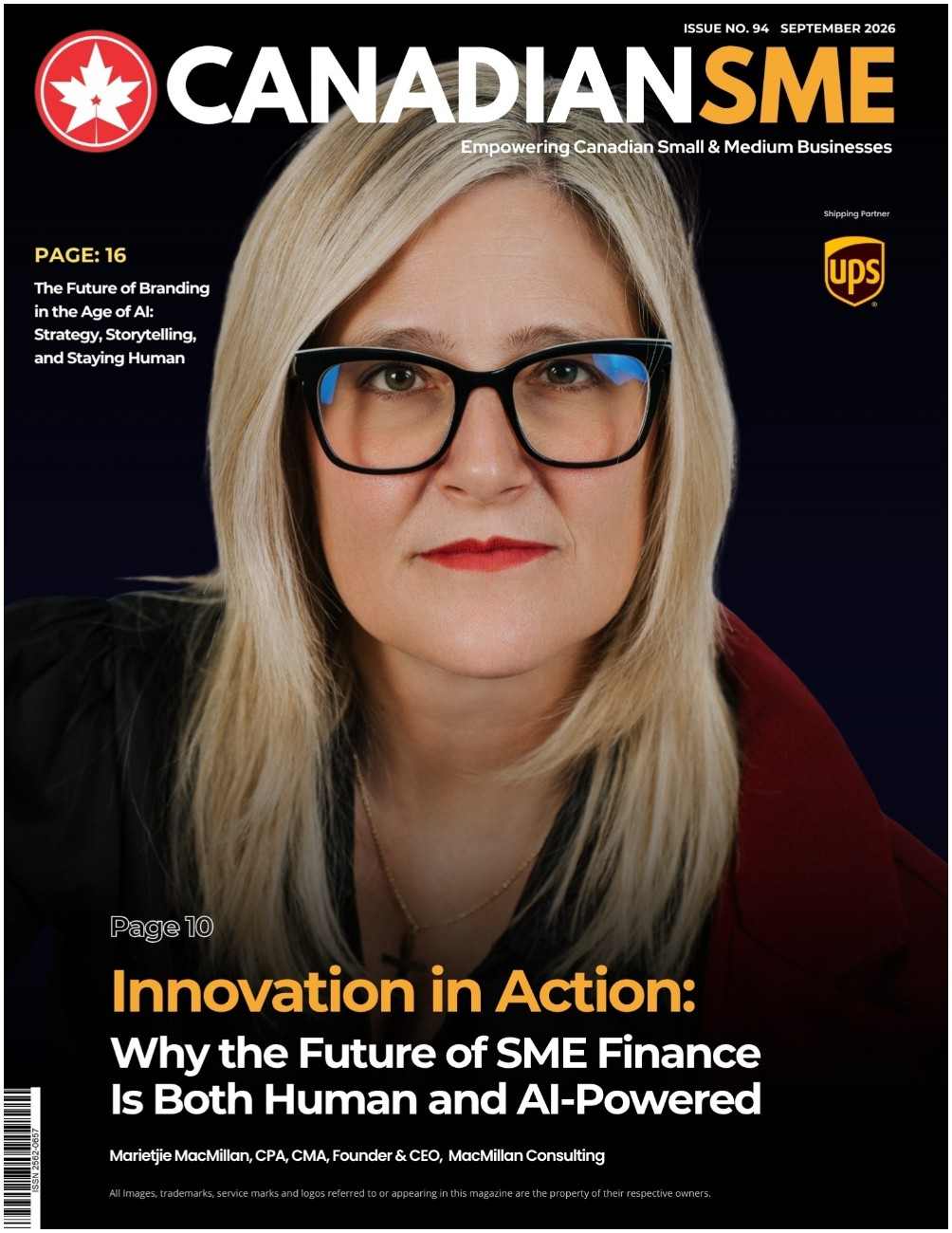
By Marietjie MacMillan, CPA, CMA — Founder & CEO, MacMillan Consulting
Ask most founders what holds their business back, and they’ll point to budget. Spending almost three decades in executive finance — and after sitting on the “Innovation in Action” panel at the CanadianSME Small Business Show this May — I’ve come to believe the real constraint is something else.
“Companies don’t have a budget problem. They have a structure problem.”
Growing companies rarely stall for lack of ambition. They stall because their finance function was built for where the business used to be, not where it’s headed. Bookkeeping keeps the lights on, but no one is turning numbers into decisions. Expansion gets debated in meetings when it should be modelled into forecasts and built into a plan. Sustainable growth ends up a slogan instead of a strategy.
Innovation in finance isn’t a new piece of software. It’s a better way of organizing expertise around the decisions that move a business forward. Two forces — one human and one technological — are quietly reshaping what’s possible for small and mid-market companies.
The human force is access. For years, senior financial leadership was priced for large enterprises and out of reach for the founder-led businesses that needed it most. That’s changing. Fractional executives, on-demand specialists, and project-based advisory now let a $1M company tap the same calibre of CFO, controller, and FP&A expertise a far larger company relies on — at a fraction of the cost, and only when it’s needed. The seat no longer has to be full-time to be world-class.
The technological force is AI. Used well, it compresses the time between a question and an answer. Reconciliations that took days take hours. Scenario planning that once waited for quarter-end becomes a live conversation. But — and this matters — AI doesn’t replace financial judgment. It amplifies it. A forecast is only as good as the strategist reading it. Numbers exist to serve people, not the other way around.

That idea — what I think of as humanized finance — is the thread tying the two forces together. Technology and access only create value when they help a real person make a better decision about a real business.
For SMEs planning their next phase, three principles turn that philosophy into action.
Build structure before you add headcount. Most growing businesses don’t need more people in finance. They need the right expertise, organized around the right decisions, at the right moment. Define what you need before you hire.
Treat strategy as standard, not a luxury. A finance function that only records the past is a cost. One that shapes the future is an investment. Growth roadmaps, market-entry models, and team architecture shouldn’t wait until you can afford a full executive team.
Let speed be a feature. With distributed teams working across time zones, strategy set during one business day can be executed overnight — so founders wake up to work already in motion. In a market that rewards the fast, structure plus technology becomes a real advantage.
The businesses building our economy deserve finance support that matches their ambition. That’s the gap worth closing.
Innovation in action isn’t about doing more. It’s about being built right: human judgment at the centre, technology accelerating it, and strong expertise finally within reach of the companies driving growth forward.
For Canada’s small and mid-market businesses, that isn’t a luxury anymore. It’s becoming the new standard.
Author – Marietjie MacMillan, CPA, CMA
Marietjie MacMillan, CPA, CMA, is the Founder & CEO of MacMillan Consulting, a finance back-officepartner delivering executive-level strategy and execution to founder-led and midmarket businesses across Canada, the United States, and the United Kingdom. With nearly three decades in executive
finance, she built MacMillan Consulting to close a long-standing gap in the market: making elitefinance leadership accessible to growing companies without the full-time cost. Through Talent-as-a- Service, Fractional Services, and MMC/MMA Consulting — and an owned talent pool spanning Canada and South Africa via her sister company, MacMillan Mzansi Accountancy, which she owns outright — her team pairs globally credentialled people with AI-enhanced workflows and a 24-hour execution cycle, with strategy included as standard. Marietjie champions “humanized finance”: the belief that numbers exist to serve people, not the other way around.


