Ten Canadian Innovators Turning Research into Results Earn 2026 Mitacs Innovation Awards

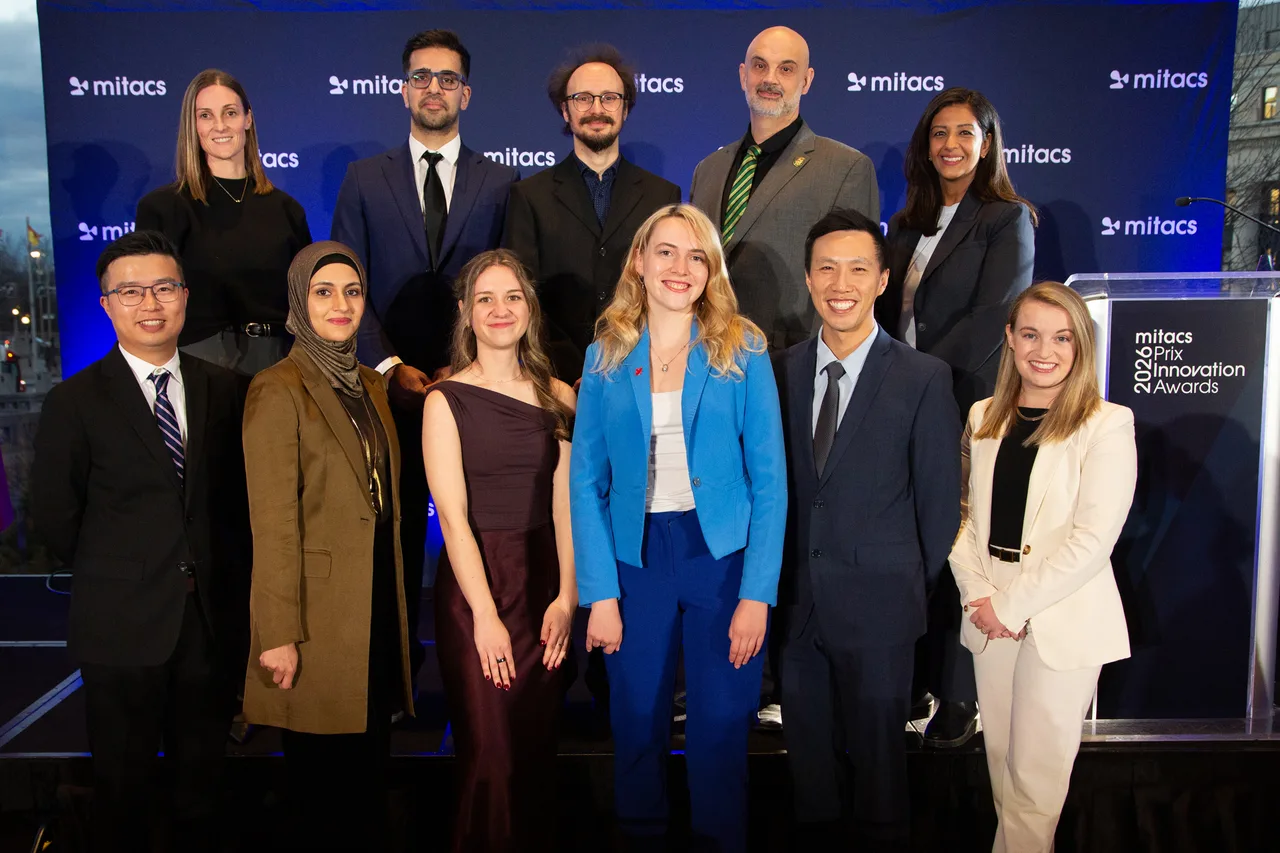
Image courtesy: Mitacs
Ten Canadian innovators won 2026 Mitacs Innovation Awards in Ottawa for made-in-Canada breakthroughs in AI, quantum computing, clean water, healthcare and apparel, from start-ups Xatoms and PragmaClin to lululemon and Xanadu.
Ten Canadian innovators were recognized at the 2026 Mitacs Innovation Awards for made-in-Canada breakthroughs – from discoveries that boost the “intelligence” in AI and purify industrial water from contaminants, to an AI-powered Parkinson’s assessment system and a first-of-its-kind workplace program for adults with ADHD.
The awards were presented at the National Arts Centre in Ottawa on November 23, 2026. Ten Mitacs Innovation Awards were given across six categories: Outstanding Innovator (four), Canadian Start-Up Innovator (two), Outstanding Research Leadership, Inclusive Innovator, Canadian Enterprise Innovator and, new this year, the Mitacs Vanguard Award.
Outstanding Innovator
Philippe Brouillard, a PhD at Université de Montréal (UdeM) and Mila, the Quebec Artificial Intelligence Institute, earned the award for his breakthrough work to boost the “intelligence” in AI by improving causal discovery – answering why things happen through cause-and-effect rather than just surface-level correlations – which until now has worked only on small, simple data sets or relied on assumptions that don’t hold up in real life. A former Mitacs Accelerate program participant, he created a novel AI method that combines causal discovery with neural networks, powerful machine-learning tools that can learn from huge data sets. The method teaches computers to accurately find cause and effect for real-world applications and is benefitting industries from healthcare to climate.
Amirhossein Foroughi, a Master of Science in Electrical Engineering graduate from the University of Calgary, earned the award for developing a real-time AI monitoring and prediction system that’s improving the efficiency and quality control of carbon nanofibre production. An outcome of his work through the Mitacs Accelerate program with cleantech start-up Carbonova, his discovery enables carbon nanofibre producers to forecast product quality while a production run is still underway, instead of waiting for post-run lab results – substantially cutting down on wasted batches, labour and energy.
Mehreen Zaman, an evaluation scientist who earned her PhD from the University of Toronto’s Dalla Lana School of Public Health, received the award for helping pave the way for more accessible and equitable maternal healthcare, offering new hope for women facing high-risk pregnancies and significant barriers to care in resource-limited settings. Equipping and monitoring 50 women in Pakistan with a digital health app called Raabta, her study, supported by the Mitacs Accelerate program, demonstrated that early detection of health concerns such as preeclampsia – a high-blood-pressure complication during pregnancy – can save lives.
Yale Zhu, a PhD and Mitacs Accelerate postdoctoral fellow at the University of British Columbia (UBC), earned the award for co-inventing a breakthrough bio-based alternative to expanded polystyrene (EPS) – the commonly used but difficult-to-recycle, petroleum-based packing and insulating foam. Working with Yinka Dene Economic Development Limited Partnership (YLP), the business arm of Wet’suwet’en First Nation, and a UBC wood-science team, he developed and scaled up what his group has named “wood foam.” The foam is produced largely from forest and manufacturing residues, particularly those that might otherwise be burned or discarded.
Canadian Start-Up Innovator
Diana Virgovicova, a recent computer engineering graduate and Mitacs Accelerate Entrepreneur program participant at the University of Toronto, and now CEO of Toronto-based cleantech start-up Xatoms, earned the award for developing a groundbreaking water purification technology that is benefitting industries that rely on clean water for their production processes, from textiles and mining to food and beverages. The process removes complex contaminants from industrial wastewater by combining AI and quantum chemistry with light. In just two and a half years, Xatoms has scaled up to commercialization with customers in Canada, the U.S., Japan and Asia.
Bronwyn Bridges, a PhD candidate and Mitacs Accelerate Entrepreneur program participant at Memorial University’s School of Pharmacy, and now CEO of St. John’s-based medtech start-up PragmaClin Research, earned the award for a technological breakthrough that speeds up Parkinson’s assessments. Her company has developed a novel AI-powered mobile assessment system, called PRIMS™ (PragmaClin’s Real-Time Intelligent Medical System), that objectively scores the motor symptoms of movement disorders in clinic and hospital settings, with results reviewed by clinicians. The system is being trialed in clinics and hospitals worldwide, standardizing Parkinson’s motor scoring and enabling specialists to focus on more critical patient care.
Inclusive Innovator
Chloé Voyer, a PhD student in mental health at McGill University, earned the award for developing a groundbreaking program that helps adults with ADHD succeed in the workplace. With limited research available on practical, accessible interventions for this population, she worked with her team through the Mitacs Accelerate program to introduce a first-of-its-kind initiative that gives employees living with ADHD access to tools and strategies to help manage the daily challenges associated with the condition. Results of her study demonstrated marked improvements in participants’ quality of life at work.
Outstanding Research Leadership
Dr. David Bressler, Professor in the Department of Agricultural, Food and Nutritional Science and Vice-President International, Innovation and Enterprise at the University of Alberta, earned the award for his disruptive work to turn leftovers from forests and farms into commercial products such as sustainable fuels and food ingredients. His low-carbon contributions to Canada’s bio-industrial sector are helping Canadian companies innovate for a cleaner economy. Dr. Bressler’s research has involved about 40 local, national and international post-secondary students, graduate students and postdoctoral fellows supported by Mitacs, who have helped take discoveries from the lab to market.
Canadian Enterprise Innovator
lululemon earned the award for helping build one of Canada’s most established industry-academic research ecosystems. Through long-standing partnerships via Mitacs programs with Canadian universities, students and leading experts in human physiology and psychology, lululemon has expanded scientific understanding of human performance while translating research into product innovation designed to support consumer performance and wellbeing. These collaborations let emerging researchers contribute to discoveries that inform lululemon’s approach to performance apparel, footwear and accessories, and some participating Mitacs students have gone on to land full-time positions with the company.
Mitacs Vanguard Award
Xanadu earned the inaugural Mitacs Vanguard Award for transforming homegrown research into world-changing innovation, tapping into Mitacs’ talent pipeline to drive breakthroughs in photonic quantum computing. The special recognition celebrates an extraordinary Canadian business that has collaborated with Mitacs to translate Canadian research and talent into a transformative innovation of international significance, while creating high-value jobs and long-term economic opportunities in Canada. It honours Xanadu’s growth as a quantum computing pioneer, using Mitacs-supported research to develop the Borealis and Aurora quantum computers and the PennyLane software platform, now one of the leading global tools for programming quantum computers.
What Leaders Are Saying
“Congratulations to the 10 extraordinary 2026 Mitacs Innovation Award winners whose achievements are delivering results for Canada. The students, postdoctoral fellows, entrepreneurs and business leaders we are honouring embody the best of this country: ambition, ingenuity, collaboration and a determination to make a difference. Mitacs is proud to play a role in their success, because we know that when talent, researchers, and businesses come together, ideas become enterprises, careers take root, and communities grow stronger,” said Dr. Stephen Lucas, CEO of Mitacs.
“These outstanding innovators are helping transform Canadian research excellence into real-world solutions that strengthen our economy, improve lives and create new opportunities for Canadians. Through partnerships between researchers, businesses and institutions, Mitacs is helping develop the talent and ideas that will drive Canada’s prosperity and competitiveness for years to come,” said The Honourable Mélanie Joly, Minister of Industry and Minister responsible for Canada Economic Development for Quebec Regions.
“Their achievements showcase the power of Canadian innovators to develop homegrown innovations, including transformative artificial intelligence technologies, that address real-world challenges and create tangible benefits across the economy. By bringing cutting-edge discoveries from the lab to the marketplace, they are helping organizations and communities thrive, strengthening Canada’s sovereignty while building a more prosperous future for Canadians,” said The Honourable Evan Solomon, Minister of Artificial Intelligence and Digital Innovation and Minister responsible for the Federal Economic Development Agency for Southern Ontario.
About Mitacs
Mitacs delivers the return on innovation Canada needs now by connecting big ideas, people and ambition to turn potential into results. Mitacs co-funds innovation partnerships that get Canada’s businesses and researchers where they need to go, helping partners innovate faster, commercialize sooner, compete globally and scale. It creates jobs and equips students and postdoctoral researchers with skills, industry experience and professional networks. A not-for-profit organization founded in 1999, Mitacs is funded by the Government of Canada, the Government of Alberta, the Government of British Columbia, Research Manitoba, the Government of New Brunswick, the Government of Newfoundland and Labrador, the Government of Nova Scotia, the Government of Ontario, Innovation PEI, the Government of Quebec, the Government of Saskatchewan and the Government of Yukon.