Anastasiia Shumilo From Developer to Founder: Shumi Technologies’ AI Vision

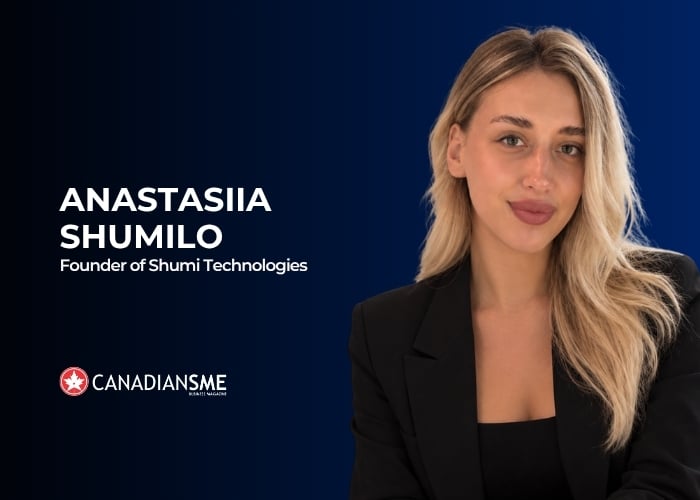
In an exclusive interview with CanadianSME Small Business Magazine, Anastasiia Shumilo, Founder of Shumi Technologies, shares how her journey from software development to entrepreneurship shaped her approach to building practical AI-powered solutions. With a focus on solving real business challenges, Anastasiia discusses why successful technology should begin with understanding workflows, identifying inefficiencies, and creating tools that deliver measurable value.
Interview By Kripa Anand
Anastasiia Shumilo is the Founder & CEO and Software Developer at Shumi Technologies, a Toronto-based technology company focused on AI-assisted B2B SaaS development for the international market. As a hands-on founder and developer, she works across SaaS product development, web development, AI integration and automation, and custom software applications.
Anastasiia is currently developing DrawFlow, an AI-powered construction technology platform designed to streamline blueprint analysis, material takeoffs and estimating workflows. Her work focuses on turning real-world business challenges into scalable digital products and software solutions.
What inspired your transition from web developer to technology founder, and how did your journey from Ukraine to Canada shape the way you approach entrepreneurship and software development?
My transition from web development to technology entrepreneurship came from wanting to move beyond simply implementing requirements and start solving the problems behind them. As I gained experience in software development, I became increasingly interested in why certain business processes remain inefficient and how technology could redesign them rather than simply digitize them.
My journey from Ukraine to Canada also shaped this mindset. Starting over in a new country required adaptability, independence, and a willingness to learn continuously. It taught me to become comfortable with uncertainty and to approach challenges as problems that can be broken down and solved step by step.
Today, I combine those lessons with my experience in software development and AI-assisted development. I start by identifying a real operational problem, understanding the existing workflow, and then determining whether AI, traditional software engineering, or a combination of both is the right solution.
Becoming a founder has also changed how I think about engineering. I am no longer focused only on whether something can be built. I think about whether it solves a meaningful problem, whether users can trust it, whether it can scale, and how it can become a sustainable product.

Shumi Technologies focuses on AI-assisted B2B software and practical digital solutions. What business problems are you most focused on solving, and why do you believe AI can help businesses reduce the burden of repetitive, manual work?
I am particularly interested in business processes that require professionals to spend significant amounts of time manually reviewing information, transferring data, counting or organizing items, and preparing repetitive outputs. These processes are often necessary, but they can take valuable time away from higher-level decisions that require human experience.
I see AI as a powerful tool for assisting with these workflows because modern AI systems can process large amounts of unstructured information, identify patterns, extract relevant data, and generate structured outputs much faster than traditional manual processes.
However, I do not believe AI should simply replace a human workflow. In many professional environments, accuracy, context, and accountability are critical. The better approach is to use AI for the parts of the process where it provides an advantage while keeping humans involved where judgment and verification are required.
That is the philosophy behind Shumi Technologies. I am interested in building B2B products where AI is integrated into a real workflow and produces a measurable practical benefit. The question I start with is not “How can I use AI?” but rather “What is taking professionals too much time, and how can technology make that process significantly better?”
You are building DrawFlow, an AI-assisted platform for blueprint analysis, material takeoffs, and construction estimating. What inspired this product, and how can technology simplify these workflows for construction professionals?
DrawFlow was inspired by a very practical problem in construction: estimating can require professionals to spend hours reviewing drawings, locating relevant elements, counting materials, interpreting dimensions, and transferring that information into an estimate. The challenge becomes even greater when a project contains many pages or multiple levels and trades.
The idea behind DrawFlow is to use AI-assisted document and image analysis to help transform construction drawings into a more structured estimating workflow. Instead of requiring an estimator to manually search through every page and repeatedly identify the same types of information, the system is designed to assist with detecting relevant elements, organizing them, and connecting them to materials and estimating data.
An important principle of the product is that AI output should remain transparent and reviewable. The user should be able to understand what the system identified and connect the result back to the original drawing rather than receiving an unexplained number.
DrawFlow is currently in product development, and my focus is on building and validating the core workflow before a broader launch. The long-term goal is to reduce repetitive estimating work while keeping experienced construction professionals in control of the final decisions.

As both Founder and Software Developer, how do you combine technical development, AI, and business strategy when creating a new product from the ground up?
I approach product development by connecting three questions: What problem are we solving? What technology can solve it effectively? And how can the solution become a useful and sustainable product?
As a founder, I need to understand the user, the workflow, the business value, and the assumptions behind the product. As a software developer, I need to turn those assumptions into a system that is reliable, maintainable, and scalable. AI adds another layer because its outputs can be powerful but are not automatically correct.
That is why I believe AI-assisted development requires a strong validation mindset. When AI generates code, analyzes information, or produces an output, the result needs to be tested against the original requirements and the expected behavior of the system. I think about scope, reliability, security, regression risk, and where human review is necessary.
I also try to avoid using AI simply because it is available. Sometimes traditional deterministic software is the better solution; sometimes AI provides a significant advantage. Good product engineering is knowing the difference.
Combining these perspectives allows me to think about technology not just as something to build, but as a system that must ultimately create measurable value for the people using it.
What challenges have shaped you as a young founder and developer, and what advice would you give Canadian entrepreneurs who want to use AI to solve practical problems and build scalable businesses?
One of the biggest challenges has been learning how to build while dealing with uncertainty. As a young founder, you often have to make decisions before you have all the information. At the same time, you are learning new technologies, validating assumptions, developing the product, and trying to understand the market.
That experience has taught me that you do not need to have the entire path figured out before you begin. What matters is identifying the next meaningful problem, testing your assumptions, learning from the result, and continuing to improve.
My advice to Canadian entrepreneurs interested in AI is to start with a real problem rather than with the technology itself. Speak with people who experience the problem, understand how they currently solve it, and identify where AI can create a meaningful advantage.
I would also encourage founders to think carefully about reliability and trust. AI can accelerate development and automate complex tasks, but businesses still need predictable outcomes and accountability.
The technology is evolving quickly, but the fundamentals of entrepreneurship have not changed: understand the customer, solve a real problem, validate the solution, and build something people have a reason to use. AI should strengthen that process rather than replace it.
Disclaimer: The views and opinions expressed in this interview are those of the guest and do not necessarily reflect those of CanadianSME Small Business Magazine. Content is presented for business insight and inspiration only; readers are encouraged to seek independent advice for specific business decisions.