Rural Seaweed, Global Skincare: 7 Fathoms’ Journey
In an exclusive interview with CanadianSME Small Business Magazine, Courtney Howell and Terrence Howell, co-founders of 7 Fathoms...
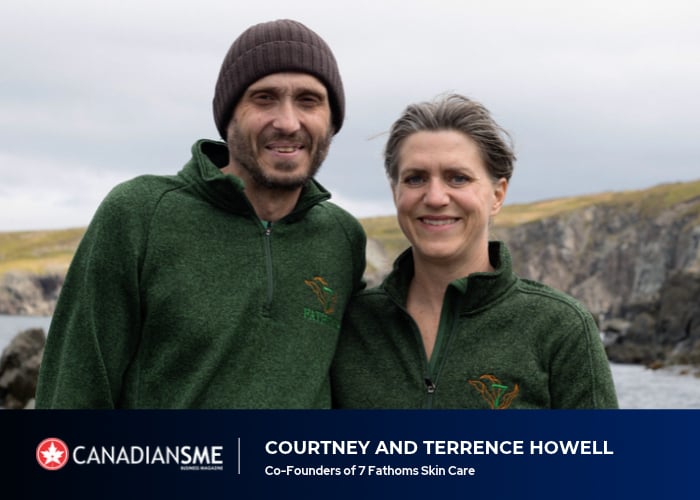
Courtney and Terrence Howell, co-founders of 7 Fathoms Skin Care, wearing matching green pullovers by the coast.
- The Howells began with a personal question about whether seaweed could ease Terrence's skin irritation, not a business plan, and built a company from that curiosity.
- 7 Fathoms harvests, extracts, formulates and manufactures in rural Newfoundland and Labrador, and says that hands-on control lets them define quality at every step.
- Research partners, mentors and incubators helped them grow, and they say a rural location is a foundation for innovation, not a disadvantage.
In this article10 sections
- A Personal Search for Relief
- You’ve described 7 Fathoms as beginning with a…
- From Beach Walk to Company
- A chance question on a walk by the shore—whether the…
- Why Newfoundland Seaweed
- You work specifically with Laminaria digitata and Fucus…
- Building Sustainably in Rural Communities
- Sustainability is central to your story—from…
- The Future of Seaweed Biotechnology
- You’ve recently appeared on Dragon’s Den, expanded…
In an exclusive interview with CanadianSME Small Business Magazine, Courtney Howell and Terrence Howell, co-founders of 7 Fathoms Skin Care, share how a personal search for skin relief inspired a seaweed-based skincare business rooted in rural Newfoundland and Labrador, scientific collaboration, and sustainability.
Courtney and Terrence Howell are the co-founders of 7 Fathoms Skin Care, a Newfoundland and Labrador-based company producing proprietary North Atlantic seaweed extracts and barrier-supportive skincare products. Inspired by Terrence’s search for relief from severe skin irritation and contact dermatitis associated with living with an ileostomy, the husband-and-wife team began exploring whether the wild seaweed growing along Newfoundland’s coastline could help support the skin.
What started with a simple question—I wonder if seaweed could help?—has grown into a company that harvests, extracts, formulates and manufactures in rural Newfoundland and Labrador.
Together, Courtney and Terrence are helping demonstrate how innovation rooted in place, community and natural resources can create relevant opportunities for rural Atlantic Canada.
A Personal Search for Relief
You’ve described 7 Fathoms as beginning with a caregiver–sufferer relationship and one very personal search for relief after Terrence’s severe skin reaction. How did that experience shape the way you see your customers today and the kind of support you want your products—and your brand story—to provide?
In many ways, we see our customers as fellow travellers on a similar journey.
When Terrence developed severe skin irritation and contact dermatitis associated with living with an ileostomy, we experienced firsthand the frustration and uncertainty that can come with searching for relief. We understand what it feels like to keep looking for something that might finally help.
That experience shaped the way we see our customers. We don’t simply see people purchasing skincare products. We see people searching for comfort, answers, and support for themselves or for someone they care about.
As we learned ourselves, skin challenges rarely affect just one person. They often create a ripple effect throughout an entire family. A spouse worries. A parent searches for answers. A caregiver invests time and energy trying to help someone they love feel more comfortable.
That understanding has shaped both our products and our brand. We want our products to provide practical support for the skin and daily comfort for the people using them, while reminding them they are not alone in their search.
That is the inspiration behind our brand promise: For skin that has been through storms, and those who care for it.
From Beach Walk to Company
A chance question on a walk by the shore—whether the seaweed thriving in harsh North Atlantic waters could help support the skin barrier—eventually turned into years of research and development. Can you walk us through how you went from that moment on the beach to building a vertically integrated seaweed skincare company that harvests, extracts, formulates, and bottles in rural Newfoundland and Labrador?
Our journey is one of curiosity, persistence and validation.
After seeing the impact that raw seaweed extract had on Terrence’s skin, our first goal wasn’t to build a company—it was simply to preserve and use it ourselves. We developed a gentle extraction process to protect the seaweed’s natural bioactive compounds and began incorporating the extracts into products used within our tourism business in Grates Cove. As guests and customers shared positive feedback, we realized that what we were experiencing wasn’t unique to our family.
A pivotal moment came when retired analytical chemist Dr. Robert Helleur became our Scientific Advisor and connected us with researchers at Memorial University. Later, Bounce Health Innovation introduced us to the BIO International Convention, which led to our acceptance into Emergence, the PEI BioAlliance’s bioscience incubator, and opportunities with the National Research Council.
Today, 7 Fathoms harvests, extracts, formulates and manufactures in rural Newfoundland and Labrador. At this stage, being closely involved in every step allows us to define the quality we want in our seaweed, extracts and finished products. Our goal is simple: to help customers experience seaweed in a way that is as close as possible to the raw extract that inspired our journey.
Why Newfoundland Seaweed
You work specifically with Laminaria digitata and Fucus vesiculosus from Newfoundland’s coastal waters. What makes Newfoundland seaweed uniquely suited for skincare applications, and what have you learned over the last decade of harvesting and working with these marine plants about their bioactive properties and how they interact with the skin barrier?
The Laminaria digitata and Fucus vesiculosus we harvest have spent millions of years adapting to the cold, turbulent waters off Newfoundland’s coast. To survive in that environment, they produce a diverse range of bioactive compounds, including fucoidan, laminarin and polyphenols, that help protect and support the seaweeds themselves.
While these species produce many of the same compounds wherever they grow, we believe the challenging conditions of Newfoundland’s North Atlantic waters influence the seaweed’s overall bioactive profile. Our job has always been to protect those naturally occurring compounds during extraction and formulate with them in meaningful concentrations. We believe that preserving a broad spectrum, full-profile extract is a key contributor to what makes our extracts distinctive and to the positive experiences our customers report.
Through both customer feedback and research, we have become increasingly interested in how these bioactive compounds may work together to support hydration, provide antioxidant protection and contribute to overall skin comfort and skin barrier health.
Through collaborations with Memorial University and the Marine Institute, we have demonstrated antioxidant, anti-inflammatory and antimicrobial activity in our extracts. Holland College has also identified promising wound closure activity and UV absorption capabilities in our seaweed extracts.
Building Sustainably in Rural Communities
Sustainability is central to your story—from responsible harvesting and long‑term ecosystem monitoring to a packaging rebrand and creating year‑round jobs in a community of about 180 people. What challenges and opportunities have you encountered building a manufacturing and marine biotechnology business in rural Newfoundland and Labrador, and how do you balance scientific research, traditional knowledge, and sustainable practices as you grow?
We see operating in rural Newfoundland and Labrador as both an opportunity and a responsibility. Being located at the source of our primary ingredient allows us to remain closely connected to the seaweed, the ocean and the ecosystems that support our business. Rather than gravitating toward larger urban centres, we believe there is value in building our company where the resource exists and bringing researchers, partners and collaborators into this environment.
Accessing specialized expertise, suppliers and research partners can require more effort than it would in a larger centre. However, we are only a little over two hours from St. John’s, and we can access the knowledge and expertise we need through partnerships, travel and plenty of Zoom calls. What we cannot recreate elsewhere is our daily connection to the seaweed and environment that inspires our work.
As we’ve grown, we’ve balanced traditional harvesting knowledge with scientific research through collaborations with Memorial University, the Marine Institute, Holland College and others. Sustainability is embedded in our decisions. We work closely with DFO, monitor regrowth, respect fallow periods and maximize our extraction process to minimize harvest volumes. Our goal is to support both healthy coastal ecosystems and healthy rural communities.
The Future of Seaweed Biotechnology
You’ve recently appeared on Dragon’s Den, expanded shipping to thousands of customers across Canada, and completed new testing on UV absorption activity in your seaweed extracts, all while repositioning as a benefits‑focused brand. Looking ahead, what does the future of seaweed‑based biotechnology in Atlantic Canada look like to you, and what message would you most like to share with small and medium‑sized businesses about the power of innovation rooted in place and community?
We are surrounded by world-class marine resources, strong research institutions and entrepreneurial communities. The opportunity is not simply to harvest seaweed, but to better understand its chemistry, develop new applications and build globally relevant businesses rooted in our coastal communities.
Our own journey began with a simple question: I wonder if seaweed could help? We didn’t begin with a business plan. We began with curiosity and a problem that needed solving. That curiosity led us to researchers, mentors, industry partners and customers who helped transform an idea into a growing company.
The future of seaweed-based biotechnology in Atlantic Canada can be built the same way—through curiosity, collaboration and a willingness to see opportunity in the resources and communities around us.
Small and medium-sized businesses shouldn’t underestimate the power of place and community. Rural locations aren’t a disadvantage. Our experience has been the opposite. The seaweed, the coastline, the community and the people of Newfoundland are not obstacles to our business. They are the foundation of it.
Some of the most innovative ideas in the world begin with a simple question and a deep connection to where you come from.
Disclaimer: The views and opinions expressed in this interview are those of the interviewee and do not necessarily reflect the official policy or position of CanadianSME Small Business Magazine. Our platform is dedicated to fostering dialogue and sharing insights that inspire and empower small and medium-sized businesses across Canada.
With an aim to contribute to the development of Canada’s Small and Medium Enterprises (SME’s), Cmarketing Inc is a potential marketing agency and a boutique business management company progressing rapidly in its scope. By acknowledging a firm reliance of the Canadian economy over its SMEs, the agency has resolved to launch a magazine, the pure focus of which will be the furtherance of Canadian SMEs, and to assist their progress with the scheduled token of enlightenment via the magazine’s pertinent content.
View profile →