Beyond Compliance: Charles Assaf on Sustainability, AI, and Business Value

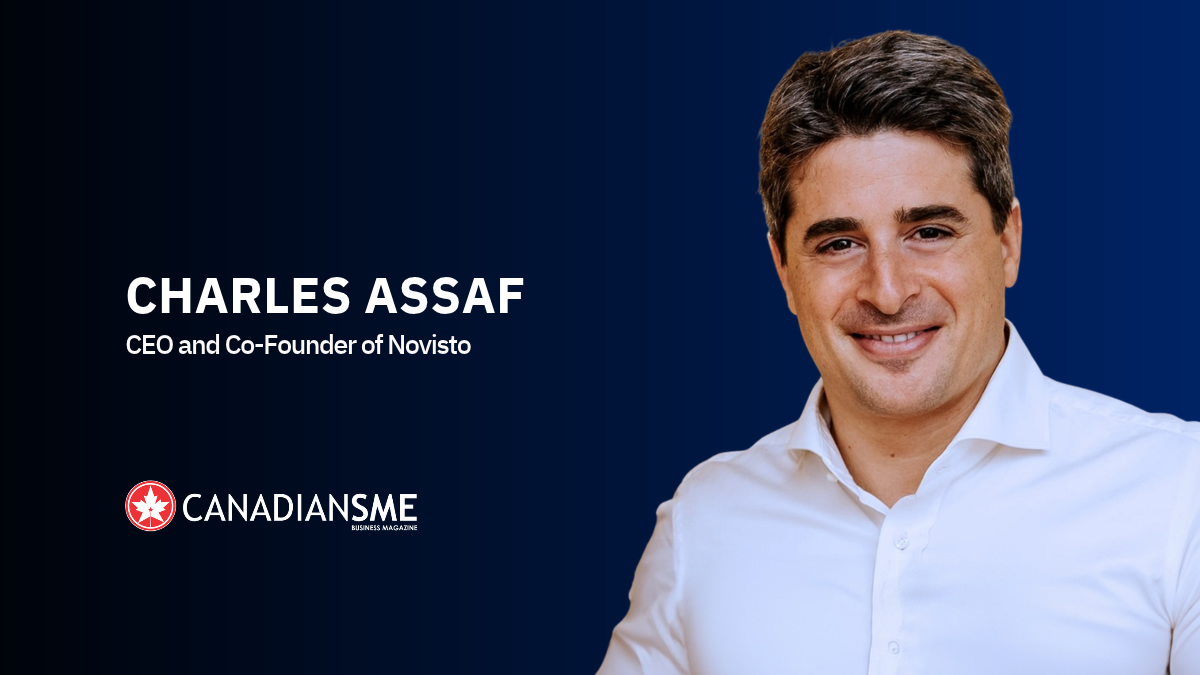
In an exclusive interview with CanadianSME Small Business Magazine, Charles Assaf, CEO and Co-Founder of Novisto, shares the lessons behind scaling a Montreal-founded technology company for global markets. He discusses connecting carbon accounting with broader sustainability performance, turning reporting data into practical business insights, and using AI to support better decisions while maintaining trust, governance, and auditability.
Charles Assaf is CEO and Co-Founder of Novisto, where he leads the company's strategy, product vision and growth as it helps global enterprises manage sustainability data, streamline reporting and make more informed business decisions. With nearly two decades of experience founding and scaling enterprise software companies, Charles also advises emerging software startups and has served on the boards of several charitable organizations.
What has driven Novisto’s 266% revenue growth over three years, and what does it reveal about demand for sustainability software?
Growth like this only happens when customers bet on you, and ours did. Three things drove it.
First, the market changed. Sustainability data used to live in a once-a-year report. Today it shapes decisions about capital, risk and growth, and investors, regulators and boards expect it to hold up to the same scrutiny as financial data. Spreadsheets and point tools can't carry that weight.
Second, we built for that moment. From day one, Novisto was designed for the world's largest organizations: governed data, full audit trails and the ability to report across dozens of frameworks using the same data. When the bar went up, we were already there.
Third, we grew with our customers. Companies that started with us on disclosure brought carbon, risk and materiality onto the same platform, because one system of record beats five disconnected ones.
What it reveals is that the demand isn't really for "sustainability software." It's for infrastructure. Companies have moved sustainability from aspiration to operation. They're managing it like any other part of the business, and they need systems built for that. Regulatory headlines come and go, but that shift isn't reversing. We're just getting started.
What has been your biggest lesson in scaling a Montreal-founded technology company for global markets?
Build for the most complex customer in the world, not the closest one.
When you start in Montreal, it's tempting to win locally first and figure out the global market later. We went the other way. We chose to serve large, multinational enterprises early, which meant meeting their standards for security, data governance and auditability before we had the scale to make it easy. That was hard at the time. It's also why we compete for global enterprise contracts today.
The second lesson: regulation is global, but it isn't uniform. One company might report under CSRD in Europe, ISSB-aligned rules in other markets and California's climate laws in the U.S., all in the same year. So we built interoperability into the core of the product instead of bolting on frameworks one at a time. Today Novisto supports 34 global standards, regulations and frameworks.
Third, Montreal is an advantage, not a constraint. The talent here in AI, software and sustainability is world-class, and Quebec's ecosystem, including partners like La Caisse, has supported us as we've grown.
For any SME with global ambitions: decide early what standards you're building to. It's much harder to raise the bar later than to start there.
How are acquisitions such as Minimum helping Novisto connect carbon accounting with broader sustainability performance?
Carbon is where sustainability gets most quantitative and most scrutinized. It's also where data most often gets stranded.
Many companies run carbon accounting in one tool, ESG reporting in another and climate risk in a spreadsheet. The same emissions figure gets re-keyed three or four times, and every handoff is a chance for it to drift. That doesn't hold up for an auditor, and it doesn't help anyone make a decision.
Minimum, a London-based carbon management company, brought specialized carbon technology, including its Carbon Atlas™, and deep expertise in emissions data. Inside Novisto, carbon now sits in the same system of record as the rest of a company's sustainability data. Collect once, report to many. The emissions figure in a CSRD disclosure is the same one behind a CDP response, a reduction target and a board discussion on transition risk, with full lineage behind it.
We had partnered with Minimum and shared enterprise customers before the deal, so we knew the fit was real. It also strengthened our presence in the U.K. and Europe.
The bigger point: carbon isn't a standalone exercise. It's one input into how a company manages performance, risk and capital.
As regulations and corporate priorities change, how can businesses make sustainability data useful beyond compliance?
Start by treating sustainability data the way you treat financial data: governed, owned, auditable and used to make decisions.
Regulations will keep shifting. Timelines move, scopes narrow, new rules appear. Companies that build their programs purely around a compliance deadline have to adjust every time the rules change. Companies that build their programs around their own business questions don't.
Those questions are practical. Where are we exposed to climate and supply chain risk? Which suppliers drive our Scope 3 emissions and costs? What do our lenders, customers and investors need to see to keep doing business with us? Is our transition plan funded and on track?
Answering them takes discipline. Collect data once and reuse it across every disclosure and request instead of rebuilding it each time. Give every metric a clear owner and an audit trail. Then close the loop: plan, capture, calculate, report, analyze and act, so insights inform how capital and operations are managed.
Do that, and compliance becomes a by-product of good management rather than the goal. Sustainability data now shapes decisions about capital, risk and growth. It deserves the same trust we give a balance sheet.
Looking ahead to 2027, where can AI make the biggest difference in sustainability management, and how should companies ensure its insights are reliable?
AI will make the biggest difference in the work nobody wants to do, and in the analysis nobody has time for.
Sustainability teams spend most of their time chasing data: emailing hundreds of contributors, reading utility bills and supplier files, and mapping the same metric to five frameworks. AI can take on much of that, extracting data from documents, flagging gaps and anomalies, and drafting questionnaire responses. That frees experts to focus on strategy.
The second shift is analysis. In 2027, I expect AI to help companies benchmark against peers, model scenarios and identify the risks and opportunities hidden in their own data, helping turn reporting into a tool for decision-making.
But AI is only as reliable as the data behind it. If your inputs are scattered across spreadsheets with no lineage, AI will give you confident answers you can't defend. So governance comes first: a single system of record, an audit trail for every number, and people reviewing and approving what matters. AI should show its work, linking every insight back to its source.
AI should make sustainability data faster to manage, not harder to trust. Speed without auditability isn't progress. It's just risk at scale.
Disclaimer:
The views and opinions expressed in this interview are those of the interviewee and do not necessarily reflect the official policy or position of CanadianSME Small Business Magazine. Our platform is dedicated to fostering dialogue and sharing insights that inspire and empower small and medium-sized businesses across Canada.