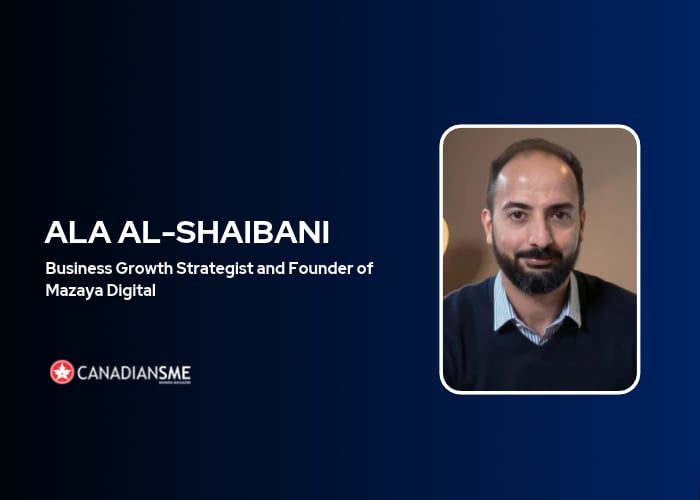
Beyond More Leads: Ala Al-Shaibani on Finding What Really Drives Business Growth
In this exclusive feature, Ala Al-Shaibani, Business Growth Strategist and Founder of Mazaya Digital, shares how small and...

Ryan Mackay (4)
In this article5 sections
In this exclusive feature, Ala Al-Shaibani, Business Growth Strategist and Founder of Mazaya Digital, shares how small and medium-sized businesses can attract customers, improve customer engagement, and simplify daily operations through strategic marketing, technology, and automation. A former Digital Transformation Strategist at Microsoft, Ala combines expertise in engineering, computer science, and business strategy with an MBA to help businesses identify growth challenges and build sustainable solutions.
Through Mazaya Digital, founded in 2021, Ala has worked with more than 50 businesses across dental care, health and wellness, hospitality, and home services. With The MOSAIC Six framework, introduced in September 2026, Ala connects local SEO, AI visibility, CRM systems, workflow automation, and customer experience to help businesses strengthen their digital presence, streamline operations, and create a foundation for long-term growth.
How has your experience at Microsoft shaped the way you help local businesses grow?
At Microsoft, as a digital transformation strategist, I worked with senior leaders at large enterprises. My job was to understand how each business worked, identify what was holding it back, and agree on priorities before deciding what to implement. The expected business benefit had to justify the investment.
That work also made me attentive to handoffs, where responsibility passes between teams and/or systems. Local businesses have those same handoffs on a smaller scale. A website form can work perfectly, yet the inquiry sits in an inbox because nobody owns the next step. The technology has done its part, but the business has still lost an opportunity.
So I ask three practical questions: what needs to happen, who is responsible, and how will we know it happened?
That shapes how I build at Mazaya Digital. A website needs to connect to a response process. A booking needs to reach the right person. Reporting needs to show what became paying business.
A small team needs clear ownership, tools it can maintain, and improvements worth the cost. That is the discipline I bring from enterprise work.
When an owner says, “We need more leads,” how do you determine whether marketing is actually the problem?
I start with paying customers and work backward.
First, how much revenue comes from new customers versus returning customers? Separately, how much new business comes through referrals? Where repeat purchases are natural, weak retention deserves attention. There may be an opportunity to earn more from relationships the business has already built.
Then I examine conversion. Of the people who inquired, how many became customers? What happened to the rest? Did someone forget to follow up, stop too soon, or leave a concern unresolved? A prospect may need several useful follow-ups before deciding.
Next, discovery: how many suitable people find the business through Google, Maps, social media, or other channels, and how many make contact? If people visit the website but don’t inquire, I examine the message, offer, proof, and ease of taking the next step.
Those checks show whether the immediate opportunity is retaining customers, converting inquiries, improving the offer, or increasing visibility. Only then is it clear whether SEO, advertising, or another channel is the right investment for new leads.
Asking for more leads before checking what happens to existing opportunities is like asking for more water without checking whether the bottle leaks.
How does your MOSAIC Six framework help business owners decide what to improve first?
I created the MOSAIC Six to help owners connect six areas of growth: Market Visibility, Offer Design, Systems, Automation & AI, Insights, and Customer Continuity.
For each area, I want to know what is falling short, what appears to be causing it, and what would change if it were fixed.
Take a contractor whose estimates rarely become jobs. If estimates arrive late, we examine Systems. If they arrive promptly but customers do not understand the value, we examine Offer Design. If an agreed follow-up process is repeatedly forgotten, Automation & AI may help.
Then we compare the possible fixes: likely business impact, setup and ongoing costs, staff time, and what needs to happen first. We choose a focused improvement, name the person responsible, and agree on a measure before starting.
Sometimes that means using an existing tool properly. Sometimes it requires a larger change. The framework helps explain why that work deserves priority and how it connects to the rest of the business.
What can local businesses realistically do to improve their visibility on Google Maps and in AI recommendations?
Start with one priority service and location.
First, check your Google Business Profile. Choose the most specific accurate primary category, list your actual services/products, correct the hours, and add a working booking or contact link.
Second, improve the page it links to. Clearly explain what you do, where you do it, and why someone should trust you. Answer questions customers ask about pricing, payment options, suitability, and what to expect. Use real examples and photos.
Third, make honest review requests part of finishing a job or appointment, using a direct review link.
Fourth, check relevant directories, professional associations, and local publications. Fix inaccurate business details and pursue relevant listings or coverage.
For AI, test customer questions: “Which dentists in Mississauga accept the Canadian Dental Care Plan?” or “I need someone to repair my furnace right now in Oakville. Who would you recommend?” Check the recommendations and cited sources, then address gaps in your website and listings.
Finally, track visibility across your service area alongside inquiries and bookings.
At one orthodontic location I support, average top-three Maps visibility across ten searches rose from 53% before I rebuilt its website and profiles to 81% three months after.
How should a small team choose its first task to automate while keeping human judgment and personal service involved?
Ask three questions about any task you want to automate. Does it happen frequently? Does it follow the same rules every time? And if it went quietly wrong for a week, would it be cheap to fix? Confirmations, reminders and routing new inquiries usually pass all three.
Draw a clear line. Let pre-approved messages handle the routine, and keep people on the moments that need judgment or warmth: a complaint, a worried customer, a pricing exception, a clinical or safety decision. When an AI reply is sensitive or unusual, a person reviews it first, and customers can always reach a human.
At a skincare clinic I support, the owner confirmed appointments and checked intake forms by hand. I automated confirmations, preparation messages and reminders to return. Allergies and medications from the intake form now reach the provider the day before each visit. The system delivers the information; the provider makes the decision.
Build in consent and privacy from the start. Run one workflow for a few weeks and compare it with before: time saved, inquiries missed, mistakes made. If it works, you’ll have the confidence to automate more, and have more time to grow the business.
Disclaimer:
The views and opinions expressed in this interview are those of the interviewee and do not necessarily reflect the official policy or position of CanadianSME Small Business Magazine. Our platform is dedicated to fostering dialogue and sharing insights that inspire and empower small and medium-sized businesses across Canada.
With an aim to contribute to the development of Canada’s Small and Medium Enterprises (SME’s), Cmarketing Inc is a potential marketing agency and a boutique business management company progressing rapidly in its scope. By acknowledging a firm reliance of the Canadian economy over its SMEs, the agency has resolved to launch a magazine, the pure focus of which will be the furtherance of Canadian SMEs, and to assist their progress with the scheduled token of enlightenment via the magazine’s pertinent content.
View profile →