Canada‑First Growth: How RVezy Scaled North America

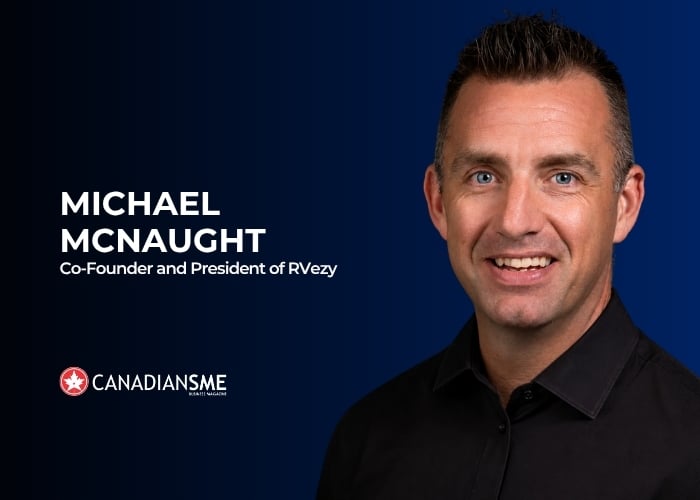
In an exclusive interview with CanadianSME Small Business Magazine, Michael McNaught, Co-Founder and President of RVezy, shares how a personal experience with RV ownership led to the creation of a new category in Canada’s sharing economy. From identifying an overlooked opportunity to building a trusted peer-to-peer marketplace, Michael discusses the lessons behind scaling a platform that connects RV owners with travellers across North America.
Interview By Kripa Anand
Michael McNaught is co-founder and CEO of RVezy, a Canadian peer-to-peer RV rental marketplace that connects RV owners across Canada and the U.S. with travellers around the world.
The company started with an injury. McNaught was a police officer when he was attacked making an arrest, and during a long recovery he kept circling back to a problem he knew firsthand: as an RV owner, renting out his own RV meant dealing with insurance gaps and security headaches that nobody had solved. So he solved it. In 2016 he launched RVezy, bringing the peer-to-peer model to RVs so owners could earn money without carrying the risk themselves.
You went from police officer to tech founder after an on‑duty injury led you to rethink how RVs could be shared. How did that experience shape the way you saw the problem, and what ultimately pushed you to launch RVezy in 2016?
I have always been very entrepreneurial, even during my policing career. Whether it was running a home renovation company, selling life insurance or flipping vehicles, I always had many irons in the fire. One of my investments was a motorhome that I purchased at an auction. My plan was originally to flip it for a profit. Instead, my family used it for a family vacation at the end of the summer and I decided to test the market and put it up for rent that summer.
I covered the entire purchase price of the RV during the summer and had the opportunity to use it. I thought it was a brilliant idea being able to use the RV but offset my ownership costs by renting it. That opened my eyes to all the friction points that existed in the peer to peer industry that had not yet been exposed to vehicles. The biggest challenge was insurance. A product did not exist at the time that would permit personally owned vehicles to be used on occasion for commercial use.
I saw the opportunity almost immediately. At the time however, I was competing in bodybuilding, taking 3 classes at university, working 60hrs per week and had a wife and 3 children at home. I simply did not have the time to pursue anything any further.
After being injured on the job in 2016, suddenly time was no longer a constraint. After multiple surgeries I couldn’t work, couldn’t work-out and had finished my schooling. I continued to receive my policing salary as I recovered so I was not putting my family financially at risk.
All of those elements combined made the timing of RVezy possible. I was very comfortable that I understood what drove the market and what elements were needed to get this business model off the ground.
I believed that I had mitigated the risks of starting the company and was in a position to commit myself fulltime to the opportunity.
You essentially built the RV‑sharing category in Canada first, then expanded into the U.S.—the reverse of how most startups sequence their growth. What did starting Canada‑first give you that you couldn’t have learned any other way, and what surprised you most when you crossed the border?
I love to learn. I learn by talking to others and truly understanding the how when working on a solution. One piece of early advice that I received was to start in a market that you understand.
I spent my younger years living all across Canada and in the outdoors. I spent 6 summers working as a canoe guide in northern Ontario. I also lived in a fishing village in Nova Scotia and worked on the oil rigs of Northern Alberta. I felt that I had a great understanding of the cultural and geographical differences across Canada. I certainly did not have that comfort level in the USA.
I am glad I took that approach. While the market is smaller, I was able to learn the marketplace dynamics in a geography that I understood very well. That learning permitted RVezy to truly understand how the platform operated prior to entering the USA market which is much more competitive.
While Americans are very similar to Canadians, we are also equally as different. The USA is much more litigious. We had to rethink how we handled disputes, security screening and insurance risks.
One of the big hurdles early on was insurance, and you negotiated Canada’s first RV‑sharing insurance policy so owners wouldn’t carry all the risk themselves. What did it take to get a traditional insurer comfortable with a brand‑new sharing‑economy model, and how has that shaped trust on both sides of the marketplace?
We were not the first people to present the peer to peer model to an insurance company regarding the RV industry. We just approached it differently.
I understood that getting an insurance company to place a bet on RVezy (spending the time and money building us a product) required showing them that I was equally as committed. Others had approached the market with an idea, I approached them with a product. It was more of a “field of dreams” approach. We built the product first, had initial customers and were able to show them that the demand and market existed.
I did not understand how important that was. To be successful with the insurance company we had to truly show that there was a gap in the market currently. Without the proof of our product without insurance we would not have been able to demonstrate the gap to the regulators.
If I could lend my RV to my friend and have full insurance coverage, why would renting him the RV have no coverage? There is no change in risk.
I had suggested to the insurance company that I would rent my BBQ for $1500/week and lend people my RV. That certainly got their attention.
RVezy now operates as a truly double‑sided platform, with dedicated experiences for both RV owners and travellers. In practical terms, what makes your “one‑app” approach different from other marketplaces, and how does your “Uncommon Denominator” philosophy show up in how you serve hosts, guests, and partners like RV dealers?
We recognize that making things easy for our customers to move between renting and owning is a customer problem and we like solving problems!
We are in the travel space. People plan for months and often years for their vacation. Customer service is paramount. While we want our customers to solve their own problems, we also recognize that sometimes you need the help of a human. Since day one we have committed ourselves to ensuring that if someone truly needs us then we are there. That also led to our unique trip interruption product where in the event something does go wrong, we are in a position to fix it so that the vacation can continue.
We also understand the journey of an RV owner. Many of our renters are actually potential RV owners. They use our services as almost a try before you buy program. They get introduced to the RV industry through renting, buy an RV and then rent their RV with RVezy. To support that we created a double sided app.
While competitors require a different app for the owner and renter, we serve both customers on the same app to keep it simple.
You’ve won awards for customer service, launched a dealership partnership program, and helped thousands of people turn under‑used RVs into real income. For Canadian small and mid‑sized business owners, what lessons would you share about spotting opportunity in your own backyard—and what would you say to someone who’s on the fence about building a business on a platform like RVezy?
Early on I received quotes of over $50,000 just to help come up with a name and brand for the company. Those early days are very exciting and it is easy to get sucked into investing in the wrong problems. One early mentor told me that it doesn’t matter what you call your company, the first thing you have to do is prove that people want to buy what you are selling.
That was some of the strongest advice I was given. I didn’t realize at the time, but they were essentially referring to building an MVP and getting early customer insight.
I encourage entrepreneurs to know their customer deeply or start a business that you have extensive knowledge in and do the hard work early. It pays dividends when you truly understand your customer problems and can speak to them intelligently.
For anyone looking to build their business on top of a platform like RVezy, I think it’s important to understand that earning extra income with an asset like an RV requires effort. We’ve taken care of all of the difficult aspects, like terms of service and insurance, but in the end, the hosts earning the most enter the game with a business mindset.
Disclaimer: The views and opinions expressed in this interview are those of the interviewee and do not necessarily reflect the official policy or position of CanadianSME Small Business Magazine. Our platform is dedicated to fostering dialogue and sharing insights that inspire and empower small and medium-sized businesses across Canada.