From Startup to Sustainable: Lessons in Growth, Talent, and Operational Excellence
In this exclusive feature, Marc Kimmel, Co-Founder of OuiPay Payroll Services and Regional Vice President of Sales at...
In this article5 sections
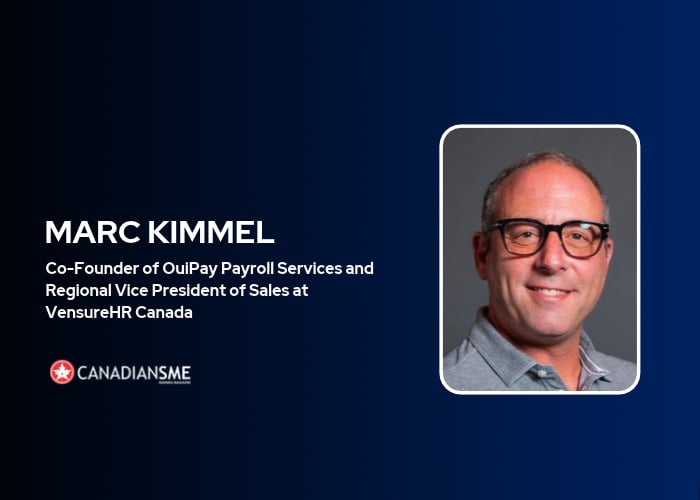
In this exclusive feature, Marc Kimmel, Co-Founder of OuiPay Payroll Services and Regional Vice President of Sales at VensureHR Canada, shares how growing Canadian businesses can simplify workforce operations and build stronger foundations for sustainable growth. With extensive experience in payroll and workforce management, Marc helps small and medium-sized businesses navigate HR, payroll, benefits, technology, and operational challenges.
Through VensureHR Canada, Marc focuses on helping businesses access the expertise, resources, and workforce solutions needed to streamline administration, improve operational efficiency, and support long-term growth. By connecting people, technology, and practical business solutions, Marc helps Canadian entrepreneurs focus on growth, innovation, and future opportunities.
You’ve helped businesses scale from early-stage to exit—what’s one operational decision that tends to make or break that transition, and why do so many founders get it wrong?
One of the most important decisions is recognizing when the business can no longer rely on the founder as its operating system. And that’s not an “if”; it’s a “when.”
In the early stages, having one person make most of the decisions feels efficient. The founder knows every employee and client, communication around the workplace feels easy and informal. Decisions around hiring or performance can be handled on a case-by-case basis.
But as the company grows, that business style becomes impossible to maintain.Employees get managers, who (without formal, standardized training) can lead to different expectations and experiences.Responsibilities get hazy when undocumented. Sometimes, even the most important processes slip through the cracks.
This doesn’t mean to introduce bureaucracy. It’s just about creating structure for the business to operate without the founder being pulled into every detail. After all, they’re likely guiding the bigger vision for the organization. As companies scale, that vision will become more critical to maintain for customers, prospects, and employees alike.
Many founders wait because informal processes helped build the company. And I understand that letting go can feel like losing control. But in reality, the right structure creates better control through visibility, accountability, and consistency.
Many SMBs struggle to balance growth with structure. At what point should a company start formalizing operations, and what are the first systems you recommend putting in place?
The best time to formalize is before growth makes existing processes harder to manage.
From an HR and payroll perspective, you start seeing signals quickly. More manual data entry, more time spent tracking down employee information. These issues are clear indicators that it’s time to put pen to paper with operations.
The first systems to get in place are your fundamentals—onboarding, employee records, payroll, time and attendance, performance management. Dig deeper than how you want them to operate. Who do you want to maintain those operations as your company is now, and then vision-cast what departments or people you’d want to own those operations as you scale.
From there, take a step back and look at how those systems work together.Fragmentation is one of the biggest issues I see in growing companies. The goal is not to add layers of red tape every time the company grows. Formalizing before growth kicks off should actually reduce the headaches, not add to them.
From your perspective, what are the most overlooked HR challenges Canadian SMBs face today that quietly limit growth?
It’s not necessarily a single process limiting growth; there’s no one fix that waves a wand when it comes to HR challenges. What I’ve seen is that businesses often outgrow processes before they even realize it.
When you’re a small company, things like manual checklists, multiple Excel files, or software workarounds can still get the job done. But as your company grows, single business owners can’t scale with stale processes.
Eventually, the Excel files become ungovernable. If you’re expanding across provinces, you add new layers of compliance and employee classification into a fragmenting process. The same processes that felt simple eight months ago suddenly don’t work.
For Canadian SMBs, I think the biggest overlooked challenge becomes the biggest opportunity: recognizing those growing pains earlier. You don’t need a bigger internal team to get started, either. You just need the processes and expertise (and maybe technology) that and scale with you.
How can SMBs compete for top talent against larger companies without significantly increasing costs or complexity?
The short (but not simple) answer is “Consistency.” SMBs shouldn’t try to imitate large employers to try and compete. After all, small businesses are the backbones of many communities across Canada.
They do, however, need to get the fundamentals right – something businesses of any size share.
At the base level, employees expect to be paid accurately and on time. That sounds simple, but as businesses grow, payroll gets more complicated. You’re adding employees, managing different compensation or time tracking tools, and potentially operating across provinces. It’s easy to assume that the bigger a company gets, the easier that consistency becomes, but that’s not always the case.
No matter how big or small, the “competition” for keeping good talent is maintaining consistency. As soon as you break that consistency, no matter your size, you’ve broken trust with your employees.
A modest program delivered well creates more trust than an ambitious program that employees cannot understand, access, or rely on.
As businesses adopt more tools and automation, what distinguishes companies that gain a true operational advantage from those that just add more overhead?
That answer all depends on whether you’re starting with a business problem or a piece of technology.
For example, companies create more overhead when they add payroll tools without deciding what should improve. Employees end up entering the same information in multiple places, which means there’s more opportunity for something to fall through the cracks. Employees have to juggle platforms, which means they find workarounds because the systems do not reflect how the business actually operates.
Companies that gain an advantage start with the workflow. What are the delays? Where are the errors? What information is being entered multiple times across spreadsheets? Companies that understand the friction points are the ones choosing the right technology to solve them.
Integration is just as important as functionality. A smaller number of connected systems will often outperform a larger collection of specialized tools that cannot share reliable information.
Automation should remove friction and improve decision-making. If a new system does not save time create a better experience for employees and customers, all you’re doing is digitizing inefficiency.
Disclaimer:
The views and opinions expressed in this interview are those of the interviewee and do not necessarily reflect the official policy or position of CanadianSME Small Business Magazine. Our platform is dedicated to fostering dialogue and sharing insights that inspire and empower small and medium-sized businesses across Canada.
With an aim to contribute to the development of Canada’s Small and Medium Enterprises (SME’s), Cmarketing Inc is a potential marketing agency and a boutique business management company progressing rapidly in its scope. By acknowledging a firm reliance of the Canadian economy over its SMEs, the agency has resolved to launch a magazine, the pure focus of which will be the furtherance of Canadian SMEs, and to assist their progress with the scheduled token of enlightenment via the magazine’s pertinent content.
View profile →