How CanWCC Advocates for Women and Non-Binary Entrepreneurs

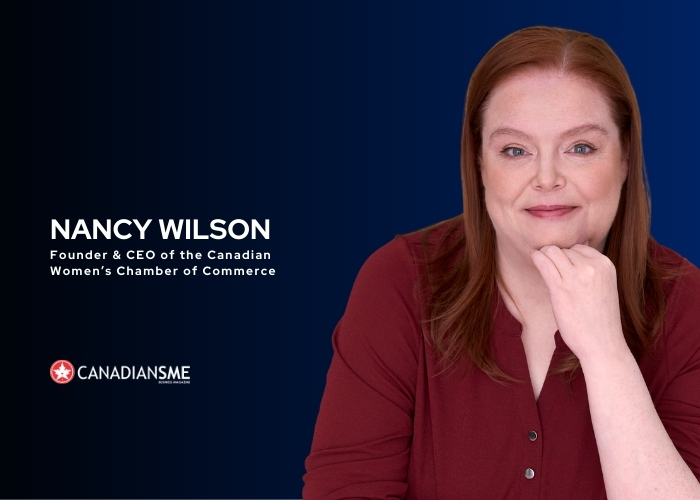
Image Courtesy: Nancy Wilson
CanadianSME Small Business Magazine interviews Nancy Wilson, Founder and CEO of the Canadian Women’s Chamber of Commerce (CanWCC), about her journey from the corporate world to founding an organization that supports women-identified and non-binary entrepreneurs. After a decade in accounting and finance roles, Nancy left the corporate world to start her own accounting and advisory practice. She noticed recurring challenges women-owned businesses faced, such as sexism and microaggressions. The obstacles inspired Nancy to establish CanWCC in January 2018 to address the barriers her clients encountered in accessing capital, securing contracts, and managing time for business growth. With CanWCC, Nancy aims to create a supportive community and advocate for the unique needs of women and non-binary business owners.
Nancy Wilson is the founder and CEO of the Canadian Women’s Chamber of Commerce (CanWCC), a national, not-for-profit organization that advocates for women-identified and non-binary business owners in Canada. Nancy is a Chartered Professional Accountant, with over a decade of accounting and finance experience in the private sector. Prior to CanWCC, she ran an accounting and advisory firm specializing in women business owners and entrepreneurs. After experiencing a lack of resources, difficulty finding connection, and numerous barriers, both as a business owner and indirectly through her clients, Nancy launched the Canadian Women’s Chamber of Commerce in January 2018.
Nancy, could you share more about your journey from leaving the corporate world to founding the Canadian Women’s Chamber of Commerce (CanWCC)? What were the key barriers and challenges you observed that motivated you to create this organization for women-identified and non-binary business owners?
After over a decade in accounting and finance roles, I transitioned from the corporate world to establish my own accounting and advisory practice, specializing in assisting women-owned businesses. Despite my CPA background, running a successful business required additional learning. I encountered familiar challenges of sexism and microaggressions, prompting me to found the Canadian Women’s Chamber of Commerce in January 2018, driven by the firsthand struggles my clients faced in accessing capital, securing contracts, and managing time for business growth.
The Alliance project recently launched its report on ‘Invisible Entrepreneurs.’ What were some of the most surprising or impactful learnings from this project about the neglect of self-employed individuals in small business policy, and how is CanWCC addressing these findings?
An important takeaway from the report is that the exclusion and neglect of self-employed individuals is a long-standing issue that is not specific to a particular leadership party or a specific decade. This is a nonpartisan issue that needs to be addressed immediately.
Secondly, the Alliance members were surprised by the consistent feedback from the focus groups. In late 2023, the Alliance conducted six regional focus groups with self-employed individuals. Across all regions, the message was clear, the self-employed are isolated and want opportunities to connect. Another common challenge is navigating tax, regulatory requirements, and government programs (where they do exist).
Finally, the composition of the self-employed was a stark reminder of the result of systemic exclusion and discrimination. Self-identified women, black, racialized, and Indigenous entrepreneurs are over-represented among the self-employed. On a positive note, this provides an opportunity for the government to efficiently direct funding and support to a group of individuals that will fulfil the government’s strategy of an inclusive economy.
Based on the outcomes of the Alliance project, what specific types of support do you believe self-employed individuals need to succeed, and how is CanWCC working to provide or advocate for these resources?
Self-employed individuals need at least three types of support: social policy, economic development policy, and community-based support. Employment Income (EI) reform should include the needs and nuances of self-employed people. Expanding universal pharmacare and dental care can also help the self-employed. Taxation reform is needed to reduce unnecessary complexity. Finally, government should continue to fund community organizations that support self-employed people, particularly those that provide opportunities for individuals to connect with one another.
CanWCC’s advocacy activities are varied; however, establishing the Alliance and promoting the report is a good example of what CanWCC does to raise awareness of and advocate for the self-employed.
Access to capital is a critical issue for many entrepreneurs, especially women and non-binary individuals. Why is this a focal point for CanWCC, and what actions or programs are you implementing to address this challenge?
CanWCC applies a feminist and intersectional lens to the issues facing our community, research, and advocacy activities. As a result, we know that what women and non-binary individuals need to start and build successful businesses is capital. Mentorship and skills-training are excellent tools but they cannot be put to use unless you have a strong, well-capitalized business. CanWCC engages with our partner network and policymakers throughout the year to discuss and advocate for access to capital.
We just launched a new program called Flip the Script, which will teach 600 women-identified and non-binary entrepreneurs across Canada how to apply evidence-based techniques that are proven to get them up to 60% more investment dollars.
With the upcoming launch of the ‘Flip the Script’ program, what can members and potential members anticipate from this initiative? How does it align with CanWCC’s broader goals to support and empower women in business?
Flip the Script is an exciting program that addresses the impact that unconscious bias plays in access to capital. It is based on award-winning research conducted by organizational scientist Dana Kanze and her team.
Flip the Script is a national, six-month program in both English and French. This pilot program, offered in English and French and funded by the Government of Canada’s Women’s Entrepreneurship Strategy Ecosystem Fund, is open to 600 women-identified and non-binary entrepreneurs across the country. Apply now at fts.canwcc.ca
At its core, Flip the Script is not just about acknowledging the existence of implicit bias; it’s about equipping entrepreneurs with the tools to challenge and overcome it. By leveraging social and organizational psychology research, Flip the Script enables women and non-binary entrepreneurs to take control of their narrative and forge meaningful connections with investors.