Jewellery With Integrity: Building Better Luxury Locally
In an exclusive interview with CanadianSME Small Business Magazine, Kesha Frank, Co-CEO and Head of Production at FTJCo,...

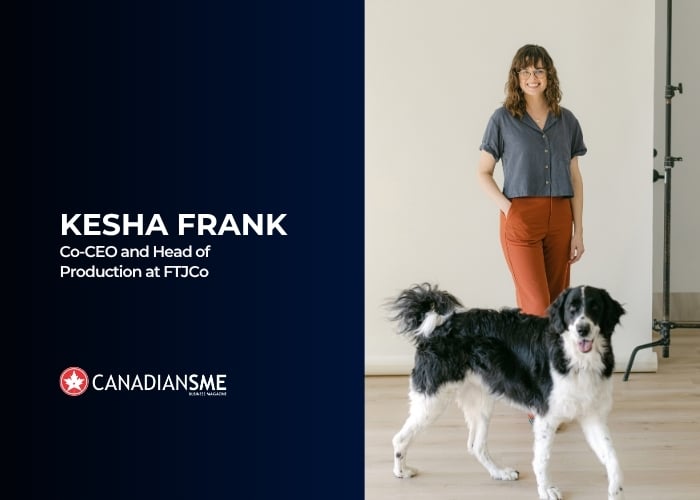
Kesha Frank, Co-CEO and Head of Production at FTJCo, standing with a black and white dog.
- FTJCo builds pieces for longevity, with design rules on metal thickness and prong placement, and avoids setting styles that can't be maintained or repaired.
- It sources materials using a 'trust but verify' process, and has dropped producers whose claims were unsubstantiated or false.
- Employee ownership took about 15 years to achieve. Kesha Frank advises SMEs to state their values clearly and make incremental changes toward a 5 to 10 year goal.
In this article5 sections
In an exclusive interview with CanadianSME Small Business Magazine, Kesha Frank, Co-CEO and Head of Production at FTJCo, shares how craftsmanship, responsible sourcing, and inclusive leadership are shaping the future of the jewellery industry. As a fifth-generation artist, goldsmith, and gem setter, Kesha discusses how her passion for creating meaningful pieces has evolved into a broader mission of building a business grounded in integrity and purpose.
Interview By Kripa Anand
As a 5th generation artist, Kesha is honoured to produce works of art that become part of the wearer’s identity. After joining FTJCo in 2015, she realised very quickly that this had the potential to be her forever home. It’s an open secret that the jewellery industry is a misogynistic space. She made it her personal mission to make FTJCo a home for strong, talented, and opinionated people who experience misogyny. She’s immensely proud to look around at the people she sees everyday knowing she’s well on her way to making that dream a reality. Kesha has held positions on the RJC board of standards, has spoken at OECD on gender issues within the metal and mineral supply chains, and crafted the first piece of work in the world from Just Gold. Her community at FTJCo is her pride, joy, and raison d’être.
You are a fifth-generation artist, a goldsmith and gemsetter, as well as FTJCo’s Co-CEO and Head of Production. What does a typical workday look like for you, and how do you balance the precision of in-house jewellery production with the wider leadership responsibilities of growing a values-led small business?
My weeks have lovely variety to them, as the majority of my time is taken up by Production and there’s a real flow to that schedule. I spend a good chunk of my day at the jewellery bench doing our gem setting and that’s really where my heart is. In the mornings I’ll remove the waxes we’ve grown overnight on our 3D printers, assess jewellery repairs that have come in, and then hopefully get tucked into my setting bench to work on our clients’ projects. As my colleagues begin their days and clients arrive for their appointments I’ll answer questions about how we might build their designs, advise on the possibilities and limitations of various gemstones, and act as a general sounding board for all things goldsmithing and gemsetting. When you make custom jewellery, there are endless iterations and thus endless questions! I’m fortunate to work with a talented team when it comes to wider leadership responsibilities. We make a lot of decisions as a collective, which is a blessing and creates opportunities for more equitable decision making.
FTJCo describes its work as “jewellery with integrity.” What does that mean in practical terms for a client choosing an engagement ring, wedding band, remount, or custom piece—and how do you substantiate claims around responsible sourcing instead of relying on sustainability buzzwords?
“Jewellery with integrity” means a few things for us at FTJCo. First it means we’re building pieces with long-term maintenance and longevity in mind. I want to build future heirlooms and not fast fashion. We have design rules to guide us, like minimum metal thicknesses, the number and placement of prongs on stones, and there are certain setting styles we avoid because they cannot be maintained or repaired. Another major aspect of our integrity is materials sourcing. Being informed about where materials are coming from and who is benefiting from them is important to making sourcing decisions, especially when it comes to high-value natural resources like diamonds and gold. We aim to source materials where the majority of the profit stays in the country of origin. We also prioritize evidence rather than assurances, relying on a “trust but verify” process. Sometimes we’ve discovered things don’t quite add up, so we’ve had to pivot away from those producers making unsubstantiated or false claims. FTJCo has a long list of certifications that help push us forward. Being a B Corp, Fairtrade and Fairmined Certified is a big part of that.

Employee ownership is central to FTJCo’s approach; the company introduced an Employee Share Ownership Program in 2022 to give participating employees greater economic and professional agency. Why was employee ownership the right model for FTJCo, and how can it help SMEs create lasting economic security, retain skilled people, and develop future leaders?
Becoming employee owned was a no-brainer for us. When you give people the opportunity to have economic agency in their workplace they develop a greater sense of ownership and pride in what they do. Between the employee ownership and our living wage certification, attracting talented and skilled people to our company has been a breeze. It contributes to an environment for people to flourish and develop in their careers at FTJCo. In the same way that we’re transparent with our customers about materials sourcing, we are just as transparent internally with our finances, policy and business strategy. Part of the goal of the employee ownership was to create more financial literacy for the folks at FTJCo; our Annual General Meetings are open to everyone at the company, shareholder or not, so everyone can learn and understand how the company is run. As people take in that learning and exposure to the financial side of the business, they have the opportunity to bloom in areas they may not have otherwise, making us all collectively richer for it.
Jewellery production has historically been both male-dominated and opaque, yet FTJCo is female-led and designs and manufactures pieces in-house in Toronto. What does local production make possible for women in skilled trades, and what have you learned about building an inclusive workplace where talented, strong-minded people can grow and lead?
When I started my education in jewellery I was under the impression that I would be entering a male dominated work force, and was pleasantly surprised to find myself in a classroom full of women and gender diverse folks. Entering the workforce was another matter. The majority of studios were run by men, and it showed. In my early days at FTJCo I found myself the sole goldsmith at our company, trying to navigate relationships with suppliers and industry partners and being met with a distinct bias against women. I made a conscious decision to buck that trend at FTJCo. It’s important to me to work in an environment that reflects the diverse clientele we cater to, after all, most jewellery is worn by women. I am building a studio, and more broadly a company, where women and gender diverse folks can thrive, and feel represented and heard. Because when women see themselves represented in leadership roles they know there’s a place for them to grow and are eager to join our team. And when they join, they tend to stay, because they feel valued, respected, and know that they can build a long and rewarding career in this inclusive company culture.
You are preparing to introduce a fully traceable natural-diamond option, sourced and tracked from individual small-scale miners and designed to create benefits for mining communities. Where do you want to take FTJCo next, and what advice would you share with Canadian SME leaders who want to build more transparent, resilient, and purpose-driven businesses without compromising on quality?
I believe the core values of your company need to be clearly articulated for your business to be successful. We are always looking to live our values when it comes to decision making at FTJCo. Building a more transparent company starts with openness and honesty, and that can feel vulnerable to share, but it humanizes the company and builds client trust. In an industry that relies so much on trust, that’s key. Living your values isn’t always easy, while we want to say ‘go all-in!’ it may be more realistic to make incremental changes, with a clear goal in mind of where you want your business to be in 5 to 10 years. For example, FTJCo leadership wanted to implement an employee ownership model pretty early on, but it took us about 15 years to turn that vision into reality.
More broadly, when it comes to climate action, we are leaving the era of the mean, and are entering the era of the standard deviation. Our climate is becoming more turbulent, making our lives more unpredictable, impacting supply chains, public demand and resource availability. Canadian SMEs that acknowledge this reality and build solutions on standard deviations will be the ones that survive, and thrive. At the same time, SMEs that focus on improving human wellbeing within planetary boundaries will be more resilient in the long term. In a post-growth reality we can have both economic prosperity and sustainability if we build our economy with an eye to developing community and public wealth, instead of focusing economic prosperity at the top. I think that’s a strong argument for employee ownership, and a very clear road map for growing your Canadian SME.
Disclaimer: The views and opinions expressed in this interview are those of the interviewee and do not necessarily reflect the official policy or position of CanadianSME Small Business Magazine. Our platform is dedicated to fostering dialogue and sharing insights that inspire and empower small and medium-sized businesses across Canada.
With her background in journalism and expertise in content strategy and digital marketing, Kripa brings strong storytelling and communication skills to the podcast. Her ability to connect with guests and draw out their unique insights ensures engaging and informative conversations. Her focus on impactful content aligns perfectly with the podcast’s mission to provide valuable resources for business growth.
View profile →