Scale Smarter, Not Harder: Building the Back-Office Foundation for Business Growth
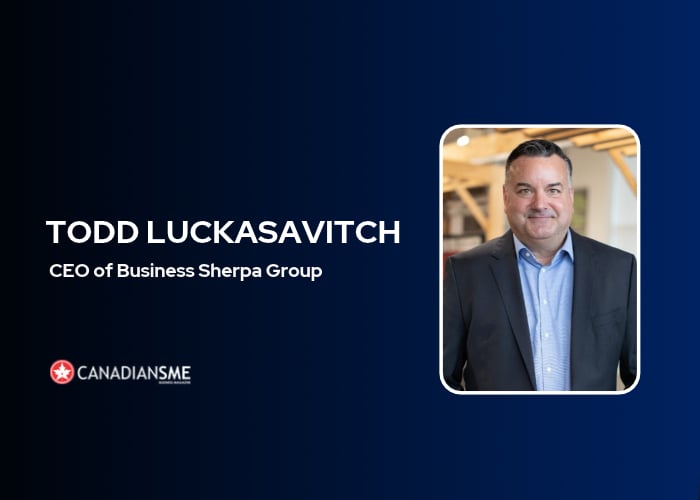
In this exclusive feature Todd Luckasavitch CEO of Business Sherpa Group, shares how he helps small and medium-sized...

- Sustainable growth needs reliable financial information, clear responsibilities, and consistent processes, so leaders should check their systems before sales outpace them.
- Clean data, clear processes, role-specific training, and licensed AI tools matter before automating; unlicensed or personal AI tools put company and client data at risk.
- Fix the biggest constraint first, and consider fractional leaders, outsourced specialists, and automation, while keeping strategy, culture, and major decisions in-house.
In this article5 sections
In this exclusive feature Todd Luckasavitch CEO of Business Sherpa Group, shares how he helps small and medium-sized businesses simplify operations and scale sustainably through strategic guidance, HR expertise, and smarter financial workflows. With extensive global leadership experience, Todd and his team provide outsourced HR, finance and accounting, bookkeeping, recruitment, and executive support.
Through Business Sherpa Group, Todd combines industry expertise, automation, and AI-driven efficiencies to help businesses strengthen their teams, optimize resources, and build a foundation for long-term, profitable growth across Canada and the United States.
Preparing for 2027
What should small and mid-sized business leaders be doing now to enter 2027 in a stronger operational and financial position
Leaders should start by asking whether the systems and processes behind the business are prepared to support its growth. Sales may generate momentum, but sustainable growth depends on having reliable financial information, clearly defined responsibilities, consistent processes, and the ability to plan ahead.
Financially, businesses need timely reporting, realistic cash-flow forecasting, and a clear understanding of which customers, services, and activities generate value. Operationally, they should identify processes that rely too heavily on one or two people, involve unnecessary manual work, or regularly cause delays or even worse impacts on quality. These impact an organization’s ability to scale a great deal.
Leaders should also look closely at capacity. Growth can quickly expose weaknesses in management, technology, staffing, and decision-making. Simply asking the existing team to work harder is not a sustainable answer.
The goal should not be to add infrastructure for its own sake. It should be to build the right foundation for the company’s next stage. That may involve improving processes, strengthening internal capabilities, adopting better technology, or using outsourced expertise. Companies entering 2027 with clear priorities, dependable information, and scalable systems will be better positioned to grow without creating unnecessary cost, complexity, or risk.
AI and workforce readiness
How is AI changing the skills SMEs need from their teams, and where are the largest workforce-readiness gaps
AI is raising expectations for how efficiently people can work, but it is also increasing the importance of human judgment. Employees need to know how to use AI to research, analyze information, prepare first drafts, and improve routine work. They also need to recognize when the output is incomplete, inaccurate, or inappropriate.
One of the largest readiness gaps is practical application. Many employees have experimented with AI, but fewer understand how to incorporate it consistently into their roles. Organizations may also lack clear guidance around privacy, accuracy, accountability, and the review of AI-generated work. Organizations also need to manage the risk of AI, ensuring employees are only using licensed tools provided by the organization for their work and tasks. The risk is high when employees use unlicensed or personal AI tools when it comes to organization and client data and privacy.
Process and data readiness is another significant gap. AI cannot compensate for a process or data that is unclear, inconsistent, or poorly managed. Before introducing automation, leaders need to understand how the work should be performed, who owns it, and where human judgment is required. They need to ensure that the data within their systems is clean, correct, properly categorized and formatted.
The most successful SMEs will provide role-specific training and establish sensible guardrails. They will treat AI as a business capability rather than simply another software purchase. The objective is not to replace people, but to help them work more effectively while preserving the judgment, relationships, and accountability that businesses depend on.
Deciding what to fund first
When resources are limited, how should a growing company decide which operational, financial, or people priorities deserve investment first
When resources are limited, leaders should prioritize investments that address the company’s greatest risk or most important constraint.
The first step is to protect the stability of the business. Poor cash-flow visibility, compliance concerns, weak financial controls, customer-service problems, and excessive dependence on a small number of employees, or even worse, a small number of clients can all become more serious as a company grows.
The next step is to identify what is actually limiting progress. For one company, it may be an inability to recruit the right people. For another, it may be inconsistent service delivery, inadequate financial information, or a leadership team overwhelmed by administrative work instead of focused on developing their employees and scaling the business. Addressing the primary constraint usually creates more value than making smaller investments across many areas.
Leaders should also decide whether to own a capability internally. Hiring a full-time executive or building an entire department may be premature. Fractional leadership, outsourced specialists, improved technology, and automation may provide the necessary capability with greater flexibility and lower fixed costs.
The best investment is the one that solves a meaningful business problem, strengthens the foundation of the organization, and creates capacity for the next stage of growth.
Warning signs of strain
What are the clearest warning signs that a company’s HR, finance, and back-office operations are no longer keeping pace with growth
A common warning sign is that leaders can no longer get timely, dependable information about the business. Delayed financial reports impact critical decisions, forecasts are unreliable, employee information is scattered, and critical knowledge resides in spreadsheets or a software understood by only one person.
Other signs include recurring payroll or invoicing issues, inconsistent hiring and onboarding, unclear responsibilities, missed deadlines, and managers spending too much time resolving administrative problems.
Growth without stronger cash flow or profitability is another important signal. It may indicate that pricing, staffing, service delivery, or financial controls have not kept pace with rising revenue.
Leaders should also watch for key-person dependency. If the absence of one or two employees would have a large impact and interrupt the operations of the business, the business has developed significant operational risk.
These symptoms do not necessarily mean the company needs more people. It may need clearer accountability, better processes, more appropriate technology, or experienced outside support. The important thing is to address the foundation before the strain begins affecting employees, customers, and financial performance.
Automation with human judgment
How can businesses use automation and outsourced expertise to scale efficiently without losing the human judgment and leadership that drive long-term success
Businesses should use automation and outsourced expertise to create capacity, not distance themselves from important decisions.
Automation works best for repetitive, rules-based activities such as data entry, workflow routing, routine reporting, scheduling, and document preparation. Removing this work allows employees to spend more time serving customers, solving problems, developing people, and making decisions that require context and judgement.
Outsourcing can provide access to financial, HR, recruitment, technology, or operational expertise that an SME may not need, or cannot yet afford, on a full-time basis. The strongest outside partners do more than complete assigned tasks. They understand the company’s objectives, improve processes, transfer knowledge, and help leadership make informed decisions.
However, accountability must remain within the organization. Leaders need to decide what to automate, what to delegate to an outside partner, and what requires internal ownership. Strategy, culture, relationships, and major decisions cannot simply be outsourced.
Scaling smarter means combining the speed of technology, the capabilities of specialists, and the judgment of leadership. When those elements work together, a business can expand its capacity without unnecessarily increasing overhead or losing the human qualities that made it successful.
Disclaimer:
The views and opinions expressed in this interview are those of the interviewee and do not necessarily reflect the official policy or position of CanadianSME Small Business Magazine. Our platform is dedicated to fostering dialogue and sharing insights that inspire and empower small and medium-sized businesses across Canada.
With an aim to contribute to the development of Canada’s Small and Medium Enterprises (SME’s), Cmarketing Inc is a potential marketing agency and a boutique business management company progressing rapidly in its scope. By acknowledging a firm reliance of the Canadian economy over its SMEs, the agency has resolved to launch a magazine, the pure focus of which will be the furtherance of Canadian SMEs, and to assist their progress with the scheduled token of enlightenment via the magazine’s pertinent content.
View profile →