What Makes Customers Care: The Marketing Strategy Behind Today’s Hospitality Brands

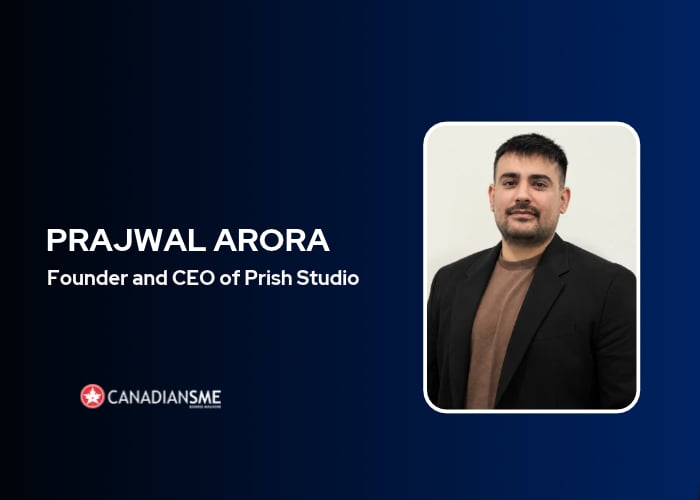
In this exclusive feature, Prajwal Arora, Founder and CEO of Prish Studio, shares how he built a bootstrapped Canadian marketing agency focused on growth for restaurants, hospitality, and brick-and-mortar retail. After working with restaurant accounts at Zomato and Skip the Dishes, Prajwal founded Prish Studio and has since worked with more than 100 brands, helping over 10 hospitality and retail businesses reach seven-figure revenue.
Prajwal discusses how AI, consumer psychology, emotional storytelling, and changing market conditions are shaping modern marketing. He also shares lessons from campaigns that generated strong organic engagement and explains how Prish Studio helps owner-operated businesses become recognizable brands through strategy grounded in operations, creativity, and measurable growth.
How is AI changing the way restaurant and retail owners make marketing and growth decisions?
AI has standardized the design, video and other work that agencies used to be known for. The average marketing or growth decision is now handled directly by AI, and that has become the new floor. What stands out now, everywhere, is original ideas. So owners are now making decisions based on strategy more than on design and video.
Speed has also gone up. What used to take weeks now takes days, so marketing is moving faster for many restaurant and retail owners.
A lot of people now call bare-minimum, average work “AI slop,” because it’s done entirely by AI. As Alex Hormozi said, a lot of founders are “using AI to do a lot of dumb things really fast.”
We used to do all the admin ourselves: presentations, formatting, design, editing. As marketers, our main work is to think, but thinking was only a percentage of the job. Now that AI can automate everything else, we get more time to think, and humans are still far better at that than AI or the average prompt. The more time you have to think, the more original ideas you have.
Why is consumer psychology often more important than simply following the latest marketing trend?
Marketing trends are generic. For restaurants, what gets a lot of views is content about restaurants or food in general. The way you stand out as a brand, with your product, your thinking and your cuisine, is by understanding consumer behaviour and how the consumer thinks.
For me, marketing is more about consumer psychology than anything else, because at the end of the day, you’re marketing to people. Why are they liking, commenting and sharing? Why are they coming to the store? Why are they making a decision? That’s based on consumer patterns you can work on, depending on what you’re trying to push.
That’s what makes a brand stand out. The only difference between a brand and a store is consistent storytelling and positioning that’s original in the minds of its customers.
It can be as simple as colour. Think of a restaurant in yellow and red, and you automatically think of McDonald’s. They’ve associated themselves with those colours for so long that it’s built into our psychology. The money they’ve spent to sit in our heads and build their reputation subconsciously is what will keep them alive for another hundred years.
How do you balance emotionally engaging creative content with measurable business results?
We, at Prish Studio, work with a funnel and different content formats. Every shoot covers one format for awareness and another for retargeting.
Ads that try to sell tend to put people off a brand. So awareness content is the emotionally engaging, creative side. Its job is to tell people the brand exists. Branding doesn’t compound in day-to-day results. It compounds when you expand or sell the brand. If a business ties everything to measurable results, the branding suffers.
Awareness formats are broader, which helps us find the niche within that audience. One of our awareness videos reached 20,000+ views organically and brought hundreds of people to the page. Then retargeting ads and email with a clear call to action can sell to them. First find the audience, then sell.
We call it create and capture. Social media creates demand; nobody watches a video at 11 p.m. and grabs their keys. But when they later search “Mexican restaurant near me,” we capture them on Google, and they remember the video.
We measure it through Google brand searches, CTR and cost per click in Data Studio, customer surveys, and month-over-month and year-over-year comparisons. Attribution is hard in hospitality, but these cues show what’s working.
What is the biggest marketing mistake owner-operated restaurants make when trying to grow?
They try to market to everyone. They don’t know their positioning. There are hundreds of restaurants, and customers have choices. They won’t come to you every time; they’ll choose one place today for one thing and another place tomorrow. You have to find your niche to find your regulars.
A lot of owners have an Indian restaurant where 70% of customers are Indian, and they want to market to other communities. There’s no point. If 70% of your customers come from one community, scale within that community first. For everyone else, you’ll be a sometimes place. Only your core audience will come back again and again.
We saw this with one of our restaurants in Scarborough. Their core audience was the Gujarati community within the Indian population, but they wanted to market to Caribbean and white customers and still see measurable results. That’s just not possible.
When you try to do everything, you end up doing nothing. That’s the biggest mistake: they build their restaurant for everyone and push it to everyone, and they become a jack of all trades.
How are trade pressures and rising operating costs changing the marketing strategies small hospitality businesses need today?
Trade pressure hits restaurants that get their produce and supplies through distributors, US producers and US manufacturers. Combined with a weak economy, it squeezes owners’ net margins. The rule of thumb is that the cost of goods sold should be 30% at most. Across the brands we work with, it’s now averaging 40–42%.
Owners can’t raise menu prices because of delivery-app discounts and competitors who are discounting, so they absorb the difference to survive.
That’s pushing marketing in two directions. Some are increasing marketing spend to bring in as many customers as possible. It used to be possible to earn 40,000–50,000 and take $15,000 home a month. Now, with margins this thin, you need 100,000–150,000 to take home the same amount, and that only happens if you market heavily.
Others are cutting every cost over 2% of the business, including marketing, to sustain revenue. In my opinion, that does more harm than good. It hurts product quality and the brand’s longevity, and people forget you quickly. One of our brands cut marketing in February, lost almost 50% of its business within two months, and came back to us in April. Now we’re not rebuilding from zero; we’re climbing out of a hole.
Disclaimer:
The views and opinions expressed in this interview are those of the interviewee and do not necessarily reflect the official policy or position of CanadianSME Small Business Magazine. Our platform is dedicated to fostering dialogue and sharing insights that inspire and empower small and medium-sized businesses across Canada.