Why Canadian SMEs Need an AI Strategy
In an exclusive interview with CanadianSME Small Business Magazine, Joshua Zaporzan, President of Audax Ventures, shares a practical...

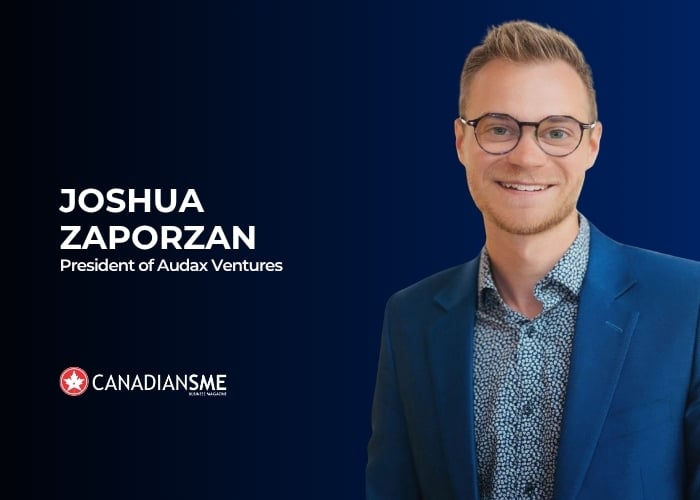
Portrait of Joshua Zaporzan, President of Audax Ventures, beside the CanadianSME magazine logo.
- Joshua Zaporzan recommends starting with a business problem, not an AI tool, then running a readiness assessment of workflows, data, technology, team skills and risks.
- He suggests a focused, measurable, low-risk first project, with a baseline set beforehand and results compared against it, counting the full cost including training and oversight.
- He says a Fractional CAIO suits businesses ready to execute, offering ongoing accountability that a one-time consultation lacks, without the cost of a full-time executive.
In this article10 sections
- Where SMEs should start
- Where should an SME start if it knows AI matters but…
- Common mistakes and hype
- What are the most common mistakes businesses make when…
- Building and measuring a strategy
- What should a practical AI strategy include, and how…
- The Fractional CAIO role
- What is a Fractional Chief AI Officer, and when is…
- Lessons from building Verclara
- Audax built Verclara to solve its own operational…
In an exclusive interview with CanadianSME Small Business Magazine, Joshua Zaporzan, President of Audax Ventures, shares a practical perspective on how Canadian SMEs can move from AI experimentation to meaningful business results. Joshua discusses why successful AI adoption should begin with understanding business challenges, assessing readiness, and identifying opportunities where technology can create measurable value.
Interview By Kripa Anand
Joshua is an entrepreneur focused on building what’s next across the renewable energy and artificial intelligence sectors.
Joshua is the Founder & CEO of H2MB, a clean energy company developing a green hydrogen production, storage, and distribution facility in Winnipeg, Manitoba. H2MB is focused on producing low-cost green hydrogen to support decarbonization, energy security, and industrial growth across Canada.
Alongside that, Joshua leads Audax Ventures, an AI strategy, custom software, and product development company that helps organizations identify, implement, and scale the practical use of artificial intelligence. Through Fractional Chief AI Officer (CAIO) services, AI strategy engagements, and custom software development, Audax works with businesses to move beyond AI planning and into execution by designing, building, and managing AI-powered systems, internal platforms, and digital products that improve efficiency, create competitive advantage, and support long-term growth.
Joshua has successfully exited a previous business, advised and invested in early-stage companies, and worked alongside founders, executives, and policymakers to help build and scale innovative businesses across Canada.
Where SMEs should start
Where should an SME start if it knows AI matters but does not know what to prioritize?
I would recommend starting with the business, not the technology. Before implementing AI tools, I encourage leaders to identify the operational challenges that consume the most time, create the most friction or limit growth. I would look for repetitive administrative work, slow customer-response times, disconnected information and processes that depend too heavily on manual effort.
From there, I recommend conducting an AI readiness assessment. This means reviewing the company’s workflows, data, existing technology, team capabilities and potential risks. Each opportunity can then be ranked according to its business value, feasibility, cost and risk.
For most SMEs, I believe the best first project is focused, measurable and relatively low risk. It could reduce the time required to prepare reports, help employees find internal information or automate part of a customer-service workflow.
AI adoption does not need to begin with a major transformation. I suggest starting with one meaningful problem, establishing a baseline, testing a solution and measuring the outcome. What the company learns from that initiative can then guide a practical roadmap for broader adoption.
Common mistakes and hype
What are the most common mistakes businesses make when adopting AI, and how can they avoid chasing hype?
The most common mistake I see is starting with a tool instead of a business problem. A company sees a compelling demonstration or hears what competitors are doing and immediately begins purchasing software. In my experience, this often creates disconnected experiments, duplicated costs and tools that employees do not consistently use.
I also see businesses underestimate the importance of clean data, employee training, governance and clear ownership. Even a powerful AI solution will struggle if the underlying information is unreliable or nobody is accountable for implementation.
To avoid chasing hype, I recommend evaluating every opportunity using the same questions: What problem are we solving? Who will use the solution? What measurable result do we expect? What data does it require? What are the privacy and security implications? Who will own it after launch?
I believe a promising AI initiative should have a clear connection to reduced costs, increased capacity, improved customer experience, better decision-making or new revenue. If that connection cannot be explained in plain business language, I would question whether the organization is ready to invest in it.

Building and measuring a strategy
What should a practical AI strategy include, and how can an SME measure whether its investment is working?
I believe a practical AI strategy must connect directly to the company’s broader objectives. It should define the business outcomes being pursued, the highest-priority use cases, the data and technology required, the people responsible, the implementation sequence and the budget.
I also recommend addressing governance from the beginning. This includes rules for acceptable AI use, privacy and security requirements, human oversight, vendor evaluation and a clear process for monitoring risk. I consider employee training and change management equally important because successful adoption depends on people understanding and trusting the tools.
For every initiative, I would establish a baseline and select a small number of relevant measures. Depending on the project, these might include hours saved, processing time, error rates, customer-response times, revenue generated, costs reduced or employee adoption.
After implementation, I recommend comparing the results with the original baseline and accounting for the full cost of the initiative, including software, implementation, training and ongoing oversight. In my view, an AI investment is working when it produces measurable value and becomes part of a better business process, not simply when the technology functions.
The Fractional CAIO role
What is a Fractional Chief AI Officer, and when is ongoing CAIO support more valuable than a one-time AI consultation?
I describe a Fractional Chief AI Officer as an executive-level AI leader who supports an organization on a flexible, part-time basis. In this role, I help leadership identify opportunities, set priorities, establish governance, build AI agents and tools, and guide implementation, without the expense or commitment of hiring a full-time executive. I believe a one-time consultation can be valuable when a business needs an assessment, an independent perspective or an initial roadmap. Fractional CAIO support becomes more valuable when an organization is ready to move beyond strategy and actually execute. Rather than delivering a report that may never be fully implemented, a Fractional CAIO provides the ongoing expertise and accountability to identify and prioritize opportunities, build and implement AI tools, measure results and continuously refine the approach. This is particularly valuable when a business has several potential AI initiatives and needs someone who can connect strategy with execution and take responsibility for turning those opportunities into measurable business outcomes.
In my experience, the real work begins once implementation starts. New opportunities emerge, priorities change, vendors and technologies evolve, and teams need support integrating AI into their day-to-day operations. As a Fractional CAIO, I can stay involved throughout that process, working alongside leadership and employees, coordinating internal and external resources, overseeing implementation and measuring whether each initiative is actually delivering value. The goal is not simply to create an AI strategy, but to turn that strategy into working solutions and tangible business results.
For many SMEs, I find the central challenge is not generating AI ideas. It is deciding which ideas deserve investment and ensuring they are implemented responsibly. Ongoing leadership provides the continuity and accountability needed to create measurable business value.
Lessons from building Verclara
Audax built Verclara to solve its own operational challenges. What did that experience teach you, and what final advice would you give Canadian SMEs looking to use AI for real business growth?
We built Verclara because the CRMs available to us did not match how we operated as a service-based business. Our client information, leads, meetings, tasks, time, costs and revenue were spread across multiple systems. We created one connected platform for our own team, and when other service businesses saw it, they told us they were facing the same problem. That interest ultimately led us to launch Verclara as a SaaS product, targeted to fractional executives, consultants & service-based businesses.
For me, the experience reinforced an important lesson: valuable technology begins with a clearly understood problem. We were not trying to create software simply because we could. We were solving a challenge we had experienced firsthand, which allowed us to test quickly whether our solution genuinely improved the way we worked.
My advice to Canadian SMEs is to approach AI the same way. I would not begin by asking, “How can we use AI?” I would ask, “What is preventing us from serving customers better, operating efficiently or growing?”
I recommend keeping the first initiative focused, involving the employees who understand the process, measuring the results and building from what works. I believe sustainable growth comes from solving real problems.
Disclaimer: The views and opinions expressed in this interview are those of the interviewee and do not necessarily reflect the official policy or position of CanadianSME Small Business Magazine. Our platform is dedicated to fostering dialogue and sharing insights that inspire and empower small and medium-sized businesses across Canada.
With her background in journalism and expertise in content strategy and digital marketing, Kripa brings strong storytelling and communication skills to the podcast. Her ability to connect with guests and draw out their unique insights ensures engaging and informative conversations. Her focus on impactful content aligns perfectly with the podcast’s mission to provide valuable resources for business growth.
View profile →