From SaaS to Defence: Connecting Canadian Tech Founders With New Opportunities

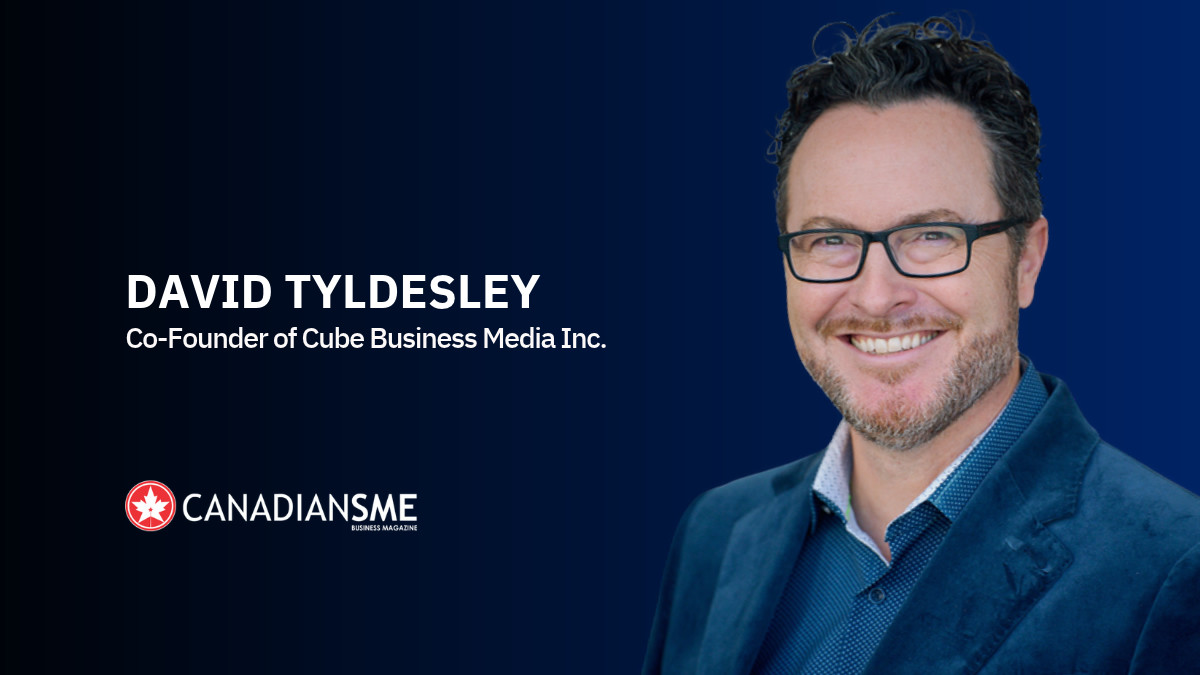
In an exclusive interview with CanadianSME Small Business Magazine, David Tyldesley, Co-Founder of Cube Business Media Inc., explores how Canadian tech founders can find customers, assess opportunities in defence, and build lasting business value while protecting their intellectual property.
David (Dave) Tyldesley is Co-Founder of Cube Business Media Inc., a Vancouver company that produces 12 annual conferences across Canada under four brands: SAAS NORTH, TechExit.io, Tech Talent North and the Business Transitions Forum.
Dave has spent more than 25 years building events from the ground up. Before Cube, he was an in-house entrepreneur at Informa, the world's largest publicly traded event company. While running IDSwest, he founded Cargo Logistics Canada in 2012, building it from a blank sheet of paper into Canada's largest supply chain event. Whether the event was about interior design, logistics or tech, his focus stayed the same: connecting people. He carried that approach into Cube, which he co-founded with Mark Stephenson in 2015 alongside the Business Transitions Forum – Cube’s first event. SAAS NORTH followed in 2016, TechExit.io in 2017 and Tech Talent North in 2021.
What are you hearing from Canadian tech founders about their biggest challenges in finding customers and growing sustainably?
The constraint has moved. A few years ago, building the product was the hard part. AI has collapsed that cost completely. Operators on our stage now build in an afternoon what cost six figures two years ago. When anyone can build, building stops being an advantage. Distribution becomes the bottleneck – how do you find customers?
That creates three problems I hear constantly. First, differentiation. An AI feature built on the same foundation models everyone uses is not a moat. Proprietary data, workflow depth and customer relationships are good moats. Second, economics. Seat-based pricing breaks when one person, or an agent, does the work of five. Free tiers now carry real compute costs for startups. Growth can look healthy while margins quietly erode. Third, buyers at home. Canada produces world-class AI talent but still lags on commercialization. Fewer large Canadian corporations invest directly in startups than their U.S. peers. So many founders land their first serious customers south of the border.
The founders growing sustainably treat customer acquisition as a core discipline, not an afterthought. They understand their unit economics before they try to scale them.

How can founders tell whether a new market is a genuine opportunity rather than a distraction from their core business?
Start with a blunt test. Does your existing technology solve a problem that buyers in that market already recognize, budget for and need solved? If you have to rebuild the product to find out, it is probably a distraction.
I look for four signals. First, fit without a rewrite - your core IP transfers. Second, the new market strengthens your roadmap instead of forking it - shared data compounds while two codebases do not. Third, you need to be able to survive the sales cycle because your core revenue funds the exploration. Fourth, you need a real customer that will pay to test it.
We want founders to learn but avoid hype. Defence is now a dinner table conversation, but founders shouldn't assume a capability gap exists simply because they can't see a solution. Sam Witherspoon, CEO of Ottawa-based defence technology company ANVIL, emphasizes finding gaps that remain unmet.
Then run a small, fast experiment. Walnut Insurance proved its partnership with National Bank in 90 days on a modest budget. Set your exit criteria before you start and if the signals are not there within a quarter or two, walk away. Saying no is also a strategy.
What inspired DEPLOY, and how will it help companies explore defence applications for their existing commercial technologies?
How can Canadian founders ignore a customer this big? With National Defence and the Canadian Armed Forces leading Canada's largest military build-out in generations, the mandate and momentum are clear. Ottawa's Defence Industrial Strategy commits $6.6 billion over five years and targets 70 per cent of contracts for Canadian firms by 2035. A BDC and Icebreaker survey found 374 of 642 SMEs want in.
Our founders kept asking us: do we belong there? Nobody had a straight answer. So we built a room to find one.
Modern defence increasingly runs on software, AI, autonomy, cyber and sensing. Canadian startups already build commercially competitive technology in all five. Our thesis is simple. Canada can build part of its defence industry the way it built its tech industry: founder-first.
The day follows three questions, in order. Build: does your technology solve a problem someone in uniform actually has? Fund: who finances dual-use companies, and what do they need to see? Sell: how does defence buy, and where can a smaller company realistically start?
DEPLOY runs November 5 as Day 2 of SAAS NORTH AI in Ottawa, presented by Dominion Dynamics. It is founder to founder, and honest about how hard this is.


For founders entering the defence market, what should come first: finding customers, securing funding, or adapting their product?
None of the three, as they are usually framed. The *problem* comes first.
Before you rewrite code or pitch an investor, prove your technology maps to a real operational need. We call it product-problem fit. A brilliant product is irrelevant if it does not address a recognized capability gap. The most reliable way to find one is to work alongside the end user and live the pain for a while. That is customer discovery, not customer acquisition.
Then the sequence matters. Build, then Fund, then Sell. Adapt the product only as far as the mission demands. Defence is a no-fail environment, so reliability, security and trust count as much as speed. Next, find capital that understands dual-use timelines. Lenders still get nervous about concentrated customers and uneven cash flow. Only then learn how the market buys.
Here is the counterintuitive part. Defence should rarely be your first market. Sam Witherspoon of Anvil has spent a decade in it, and his advice to first-time founders is to start somewhere else. Build a commercial business, make your mistakes there, then arrive with house money. Commercial revenue buys time while defence relationships mature. That is the real advantage of dual-use. Ask me in 3-5 years if founders are seeing success!
How can founders pursue major new customers while protecting their intellectual property and building long-term company value?
I am not an IP lawyer, so the contract fine print belongs with good counsel, ideally before you sign rather than after. What I can speak to is what I see across our events, from founders chasing their first big customer to the acquirers who eventually look at those companies. Two things stand out.
First, protect the relationship. In defence, it is easy to become a subcontractor whose end customer belongs to someone else. That is why DEPLOY's thesis is founder-first. Canadian entrepreneurs should be able to keep their companies, their IP and their customer relationships as they build capability. It is also a sovereignty question.
Finally, think like a buyer. At TechExit.io we spend a lot of time on what makes companies valuable. Acquirers pay for defensible IP, proprietary data, diversified revenue and clean ownership. One giant customer with rights to your roadmap is a risk, not an asset.
Win the big logo. Just never trade away the asset that makes your company worth owning.
Disclaimer: The views and opinions expressed in this interview are those of the interviewee and do not necessarily reflect the official policy or position of CanadianSME Small Business Magazine. Our platform is dedicated to fostering dialogue and sharing insights that inspire and empower small and medium-sized businesses across Canada.