

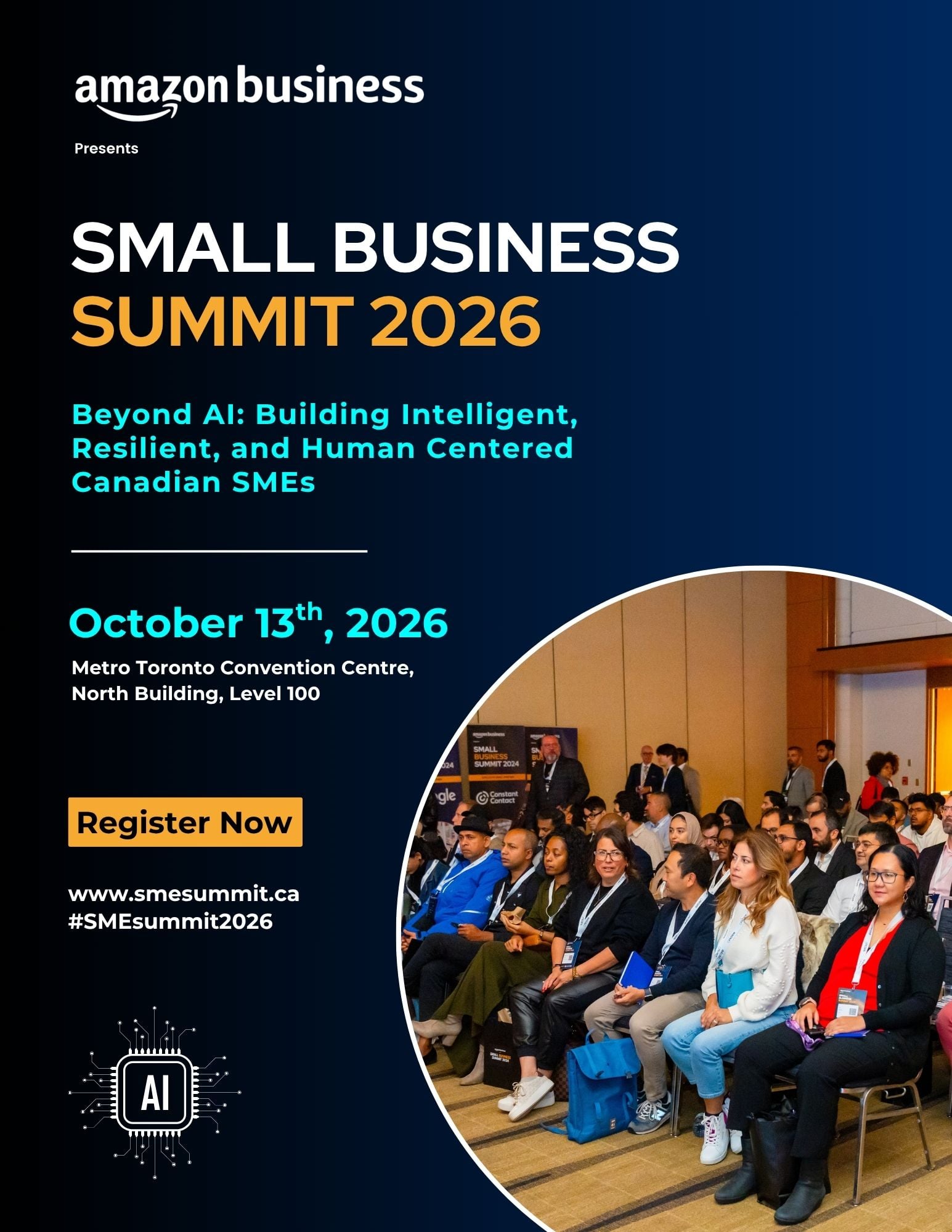


Small and medium-sized businesses (SMEs) throughout Canada are transitioning from experimental AI pilots to practical, results-driven implementations that boost efficiency, lower costs, and improve the customer experience. With the 2026 CanadianSME Small Business Summit in Toronto focusing on the theme “Beyond AI: Building Intelligent, Resilient, and Human-Centered Canadian SMEs,” business owners are becoming more concerned with what truly works in day-to-day operations rather than chasing hype or empty promises.
From Experiments to Everyday Tools
Just a few years ago, AI adoption among Canadian firms was minimal, with only a small minority reporting active usage of AI in production settings. Today, new data demonstrate a watershed moment: about 71% of Canadian SMEs currently employ AI in some form, with the vast majority reporting tangible increases in efficiency and production.
These benefits do not arise from large, custom-built systems. Instead, they are mostly the result of easily available, cloud-based tools integrated into established workflows, including email suites, collaboration platforms, CRM systems, and website builders. Small merchants and service organizations, for example, are adopting artificial intelligence to filter email inquiries, prepare initial proposal drafts, and summarize meeting notes, reducing time-consuming administrative activities to brief review steps. Owners describe AI as a tireless junior assistant who performs monotonous tasks while humans manage judgment and relationships.
Practical Stories of Impact
One frequent approach among Canadian SMEs is to begin with a single high-friction task and use AI to simplify it. A professional services firm in Toronto, for example, could use AI-powered transcription and summarization in Microsoft Teams or Google Meet to generate action items from client calls, freeing up staff time to focus on analysis and follow-up.
Similarly, an increasing number of small retailers and hotel organizations are using chatbots and virtual assistants to handle typical consumer inquiries—store hours, booking changes, and basic product questions—via websites and social media. These intelligent assistants provide 24-hour responsiveness without increasing labour costs, while complex or sensitive situations are escalated to human workers. Business owners claim shorter reaction times, fewer missed opportunities, and improved customer satisfaction, all with small subscription payments rather than huge capital investments.
Another useful use case is AI-powered analytics and forecasting. Canadian SMEs are employing artificial intelligence to discover trends in sales, website traffic, and consumer behaviour, allowing them to make more confident inventory, staffing, and marketing decisions. Real-time dashboards and smart alerts enable owners to change from reactive firefighting to proactive planning, increasing resilience in the face of economic volatility and shifting consumer expectations.

Accessible Frameworks for Responsible Adoption
To get beyond the hype, Canadian SMEs want clear rules for implementing AI safely and successfully. Several Canadian and global papers now advocate a staged approach based on five critical steps: identify pain points, select scalable tools, monitor impact, develop governance, and upskill regularly.
- Identify Pain Points – SMEs begin by sketching down their most repetitive, error-prone, or time-consuming tasks, such as billing, lead qualification, social media posting, and HR administration. Focusing on a specific pain point prevents “technology for technology’s sake” and ensures AI is directly aligned with business goals.
- Choose cloud-based, integrated tools – Rather than creating custom systems, Canadian organizations typically employ AI elements integrated into products they currently use, such as Microsoft 365 Copilot, Google Workspace, CRM platforms like HubSpot, and workflow solutions like Make, n8n, or Power Automate. This strategy keeps expenses under control and reduces integration complexity.
- Measuring ROI with Data – Before and after deploying AI, SMEs monitor indicators such as response times, error rates, customer happiness, and revenue per employee. This makes it easier to determine whether AI is having a real impact and where to extend or modify usage.
- Improve governance and trust – Canadian SMEs must consider privacy, data security, and transparency, particularly in light of changing rules and public concern about artificial intelligence. Simple internal standards, such as not putting sensitive client data into consumer AI products and using enterprise-grade platforms with clear data agreements, can help to preserve confidence and compliance.
- Invest in skill and literacy – Many Canadian initiatives, such as free “AI for SMBs” seminars and vendor-led training, aim to address the skills gap and provide teams with real experience. SMEs with higher AI literacy are more likely to identify new use cases, avoid misuse, and integrate AI in ways that truly support rather than replace employees.
Human-Centered AI for Canadian SMEs
The “human-centred” component of the Canadian SME summit concept is critical. Experts emphasize that AI should complement, not replace, human labour; the goal is more intelligent, resilient firms with greater customer and employee interactions. For many SMEs, this means utilizing AI to remove drudgery—automating paperwork, creating content, cleaning data—so workers can spend more time on strategy, creativity, and customer care.
Canadian think leaders also emphasize the necessity of integrating employees in AI decisions, explaining how tools work, and soliciting feedback on how automation benefits or hinders. This collaborative approach eliminates fear, raises ethical concerns early on, and guarantees that AI deployments mirror the lived experiences of frontline workers. In practice, human-centred AI resembles a customer service team that employs an AI assistant to recommend responses but keeps final authority, or a sales team that allows AI to assess leads while retaining human judgment about relationship details.
Building Intelligent, Resilient SMEs on a Budget
Crucially, Canadian SMEs do not require big funds to begin constructing intelligent, resilient businesses using AI. Most revolutionary use cases—chatbots, CRM automation, AI sales agents, and forecasting dashboards—are available as subscription-based products that grow with corporate size. The goal is to start small, learn rapidly, then grow where the impact is evident. Canadian SMEs are demonstrating that “beyond AI hype” is more than a slogan; it is a viable path to long-term success and resilience in a constantly changing environment.
Your role in staying up to date is integral to our shared mission of fostering a community of innovators. CanadianSME Magazine is a valuable treasure trove of entrepreneurial knowledge. Click here to subscribe to our monthly editions for updates on Canadian businesses. Follow our handle, @canadian_sme, on X to stay updated on all business trends and developments. Your support is crucial to our mission.
Disclaimer: This article is based on publicly available information and is intended only for informational purposes. CanadianSME Small Business Magazine does not endorse or guarantee any products or services mentioned. Readers are advised to conduct their research and due diligence before making business decisions.


