Loulou Lollipop: The Canadian Baby Brand Blending Safety, Sustainability and Thoughtful Design
Discover how Loulou Lollipop, a Canadian baby and children's lifestyle brand, uses intelligent design, safety, sustainable materials, and...

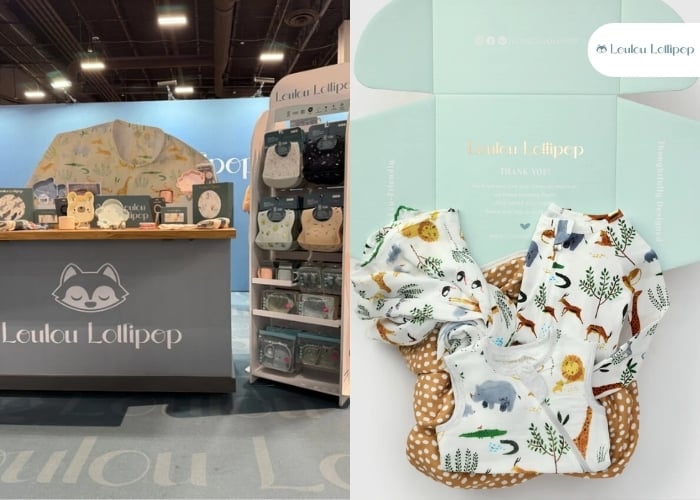
Split image showing a Loulou Lollipop trade show booth displaying baby products on the left, and an open Loulou Lollipop gift box containing baby clothes with animal prints on the right.
In this article8 sections
- From a Family Need to a Global Canadian Brand
- Designing Around the Realities of Parenthood
- Safety as a Product Standard
- Sustainability Built Into Materials
- Becoming a Certified B Corporation
- Using Business to Support Communities
- Recognition for Product Innovation
- A Canadian Brand Growing Beyond Its Home Market
Discover how Loulou Lollipop, a Canadian baby and children’s lifestyle brand, uses intelligent design, safety, sustainable materials, and family-focused innovation to support parents worldwide. For parents, even the slightest details can make a significant difference. From a baby’s first teether and feeding supplies to sleepwear, swaddles, and clothing, families increasingly want products that combine safety and functionality with thoughtful design. Loulou Lollipop, a Canadian lifestyle brand, has established its name around just this mix.
Twin sisters Eleanor Lee and Angel Kho founded Loulou Lollipop in Richmond, British Columbia, in 2015, wanting to develop safer, softer, and more appealing basics for their own families. What began as a tiny, family-inspired venture has grown into an internationally recognized baby and children’s lifestyle brand.
From a Family Need to a Global Canadian Brand
The Loulou Lollipop tale exemplifies a well-known entrepreneurship principle: some of the most successful businesses start by solving a problem that their creators have personally faced. Eleanor and Angel saw an opportunity to combine three attributes that parents frequently had to choose between: utility, safety, and current design. Their early teething products helped launch the company, but the product line has since grown significantly. Loulou Lollipop now offers a wide range of products, including sleep sacks, swaddles, baby apparel, feeding tools, teethers, tableware, and everyday accessories. Its reach has gone far beyond Canada. According to the brand, Loulou Lollipop goods are currently accessible in 37 countries and over 1,100 shops in Canada and the United States.
The company’s official LinkedIn page also touts distribution via shops and platforms like Nordstrom, Babylist, and West Coast Kids, as well as independent children’s boutiques. For a company that began as a self-funded Canadian venture, its international presence highlights how a focused product proposition can transcend borders.
Designing Around the Realities of Parenthood
Loulou Lollipop’s popularity is inextricably linked to its grasp of everyday family life. Baby products must be more than just visually pleasing. They are washed repeatedly, bitten, dropped, carried, packed into diaper bags, and used in routines that change by the hour. As a result, Loulou Lollipop has made practicality a major part of its design strategy. Its product line covers many phases of early childhood development, allowing families to move from teething and feeding devices to sleepwear, clothing, and other necessities while staying within the same brand environment.
At the same time, unique prints and whimsical motifs offer the products a distinct visual identity. The company’s website features collections with patterns ranging from Magical Dragons and Safari Jungle to Bumble Bees, Mermaids, and Sushi. This mix of usefulness and personality reflects a broader trend in children’s products: parents increasingly want practical items that blend seamlessly into the aesthetic of modern family life.
Safety as a Product Standard
When designing items for infants and young children, safety can’t be just a marketing ploy. Loulou Lollipop says it is involved in all stages of product development, including material selection, design, and construction, and uses third-party testing to ensure compliance with Canadian and US safety regulations. The company’s qualifications and standards include OEKO-TEX Standard 100, ISO 9001, and ISO 14001, and its feeding products are made with 100% food-grade silicone. The impact documents also say that silicone items are free of BPA, PVC, melamine, phthalates, and lead. For parents, these facts matter because trust is one of the most valuable assets any children’s brand can build.
Sustainability Built Into Materials
Sustainability has also become a key component of Loulou Lollipop’s brand strategy. Rather than treating environmental factors as a separate product category, the company says it evaluates materials based on environmental impact, durability, quality, and comfort. The brand’s primary materials include TENCEL™ Lyocell, bamboo-cotton muslin, and food-grade silicone. The company’s soft goods feature TENCEL™ Lyocell and bamboo-cotton muslin. Loulou Lollipop says it employs digital printing for its muslin designs to save energy and water compared to traditional printing processes.
Its silicone goods are intended as long-lasting alternatives to some typical plastics, particularly in the teething and feeding categories. The company’s sustainability efforts extend across its supplier chain. Loulou Lollipop claims its manufacturers are BSCI compliant, including fair salaries, ethical business practices, and workplace health and safety.
Becoming a Certified B Corporation
Loulou Lollipop reached a major milestone in 2023 by becoming a Certified B Corporation. B Corp certification evaluates firms on their social and environmental performance and asks them to demonstrate accountability beyond financial achievements. The accreditation coincides with Loulou Lollipop’s overall goal of incorporating environmental and social factors into its operations. The brand’s mission is to create items that are safe, sustainable, and intelligently made, all while helping to conserve the world for future generations. Its impact commitments include environmentally friendly materials, recycled-content packaging, and continual attempts to reduce environmental impact. In 2026, Loulou Lollipop emphasized that B Corp accreditation does not mean perfection, but rather more monitoring, transparency, and accountability.
Using Business to Support Communities
The company’s purpose-driven approach includes charity donations. According to Loulou Lollipop, 1% of all purchases go to charitable organizations, allowing the community to support causes related to families, children, sustainability, and social well-being. More recently, the corporation announced a Canadian donation program with Mamas for Mamas in March 2026. During the initiative, which ran until October 1, 2026, the company donated one 120 ml bottle of Canadian-made Niuriss infant formula for every order placed on its Canadian website to help families facing food insecurity. Initiatives like this show how consumer brands may link commercial activities to measurable community outcomes.
Recognition for Product Innovation
Loulou Lollipop’s expansion has earned industry recognition. Its Sleep Bag won a Good Housekeeping Parenting Award in 2025, and the company revealed four Parents 2026 Best for Baby Awards for products such as silicone bibs, sleepers, wet/dry travel bags, and silicone developmental flash cards. In 2026, the OneC™ Silicone Pacifier Clip was recognized in the Good Housekeeping Parenting Awards, following laboratory testing and evaluation by parent testers. These distinctions highlight an important facet of the brand’s evolution: innovation doesn’t always mean creating more complex products. In the baby market, it can mean enhancing a common everyday item with improved materials, construction, usefulness, or safety.
A Canadian Brand Growing Beyond Its Home Market
Loulou Lollipop’s journey from a modest Richmond-based enterprise to a worldwide distributed children’s lifestyle firm serves as an instructional example for Canadian entrepreneurs. The company was founded on a clear set of beliefs—family, safety, quality, careful design, and sustainability—and carried those principles throughout an expanding collection rather than discarding them as the business scaled. Its ongoing global expansion, including the launch of a dedicated Japanese market presence in 2026, shows Canadian consumer brands can gain relevance far beyond their home customer base. Nonetheless, the founders remain committed to the business’s original concept: family.
Eleanor Lee and Angel Kho’s experience as sisters, moms, and entrepreneurs informs their approach to developing products for parents and children. That personal base has enabled Loulou Lollipop to create a brand identity that is both playful and purposeful. As parents increasingly seek items that reflect not only how they live but also what they value, Loulou Lollipop is a uniquely Canadian example of how design, responsibility, and economic growth can coexist.
Discover Loulou Lollipop’s thoughtfully designed collection of baby and children’s essentials, created with safety, functionality, sustainability, and modern families in mind.
Explore Loulou Lollipop: https://louloulollipop.ca/
Your support is crucial in our mission to foster a community of innovators. CanadianSME Magazine is a valuable treasure trove of entrepreneurial knowledge. Click here to subscribe to our monthly editions for updates on Canadian businesses. Your role in staying updated is integral to our shared mission. Follow our handle @canadian_sme on X to remain updated on all business trends and developments.
With an aim to contribute to the development of Canada’s Small and Medium Enterprises (SME’s), Cmarketing Inc is a potential marketing agency and a boutique business management company progressing rapidly in its scope. By acknowledging a firm reliance of the Canadian economy over its SMEs, the agency has resolved to launch a magazine, the pure focus of which will be the furtherance of Canadian SMEs, and to assist their progress with the scheduled token of enlightenment via the magazine’s pertinent content.
View profile →