McCain Foods: Growing a Canadian Family Business Into a Global Food Leader
Few Canadian food corporations have deviated as far from their native beginnings as McCain Foods. McCain was founded...

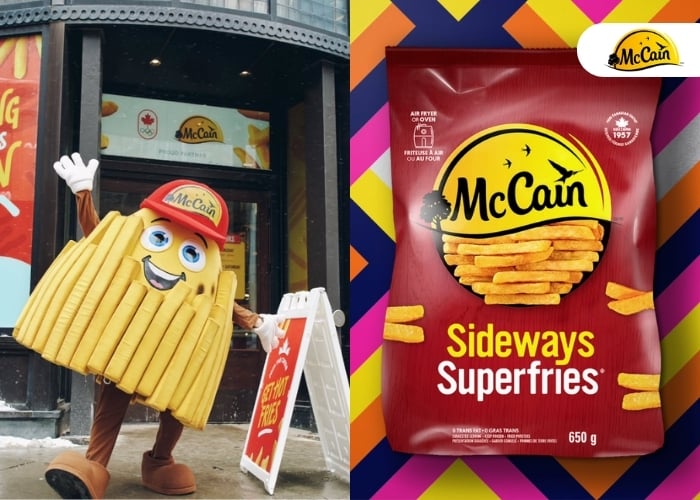
A McCain mascot in a french fry costume stands next to a sign outside a storefront, beside a bag of McCain Sideways Superfries.
In this article10 sections
- Four Brothers and One New Brunswick Beginning
- Building a Global Food Business From Canada
- Much More Than French Fries
- Working With Thousands of Farmers
- Making Regenerative Agriculture a Global Priority
- Farms of the Future Turn Research Into Practice
- Reporting Progress Through Its 2025 Sustainability Strategy
- Supporting Communities Around the World
- Continuing to Invest in Canadian Production
- Partnering With Team Canada
Few Canadian food corporations have deviated as far from their native beginnings as McCain Foods. McCain was founded in Florenceville, New Brunswick, in 1957 by brothers Wallace, Harrison, Robert, and Andrew McCain, who merged their family’s agricultural knowledge with burgeoning frozen-food technology. Their first production plant produced frozen French fries, laying the groundwork for what would become one of Canada’s most well-known global food corporations. Today, the family-owned corporation operates on six continents, offers products in over 160 countries, and has annual revenues of more than $16 billion CAD. McCain claims that about one out of every four French fries consumed worldwide is a McCain fry.
Four Brothers and One New Brunswick Beginning
The McCain tale began with agriculture. The four founding brothers were the offspring of a third-generation farming family who knew directly how important potatoes were to New Brunswick’s agricultural economy. They combined that knowledge with frozen-food production at a time when the category was opening new avenues for food preservation and distribution. McCain Foods opened its first French fry plant in Florenceville in 1957. Expansion occurred swiftly. McCain entered the United Kingdom in 1965, established its first British production facility in 1968, began selling in Australia the same year, and began exporting to the United States in 1969. This early overseas development changed a provincial New Brunswick food industry into the start of a global business.
Building a Global Food Business From Canada
McCain, nearly seven decades later, remains privately owned and tied to the McCain family. The company’s corporate offices are in Toronto, but Florenceville retains a significant component of its agricultural, manufacturing, and innovation footprint. McCain now runs 49 production sites worldwide, with over 95% in rural locations. According to the most recent corporate numbers, McCain employs around 22,000 people, collaborates with approximately 4,400 farmers, and sells through restaurants and shops in over 160 countries. President and CEO Max Koeune runs the corporation, while McCain family members continue to serve on its boards.
Much More Than French Fries
McCain’s signature dish is French fries, although the company’s range has expanded significantly. McCain claims itself as one of the world’s top producers of frozen potatoes and a global leader in prepared appetizers and snacks. Its international range has developed over decades through additional facilities, product development, and acquisitions. In Canada, the company has traditionally sold frozen potato specialties as well as snacks, appetizers, desserts, and other prepared dishes. McCain’s diversity enables it to serve both retail clients and the foodservice industry, which includes restaurants, quick-service enterprises, and other hospitality customers. However, potatoes remain fundamental to its identity.
Working With Thousands of Farmers
Agriculture remains essential to McCain’s business model. The company presently works with around 4,400 farmers worldwide, integrating global food manufacturers with local agricultural communities. McCain has long-standing partnerships with the potato-growing regions that surround its processing facilities in Canada. The connection between growers and manufacturing reflects the company’s original model. McCain’s first-generation founders were farmers, and agricultural connections are still fundamental to the company’s supply chain and sustainability strategy.
Making Regenerative Agriculture a Global Priority
Regenerative agriculture is one of McCain’s top current priorities. By 2030, the firm intends to employ regenerative agriculture practices on 100% of the global potato area utilized to cultivate McCain potatoes. Its regenerative agriculture framework is based on six principles: strengthening farm resilience, increasing crop and ecosystem diversity, protecting soil, minimizing soil disturbance, optimizing water use and agricultural inputs, and incorporating organic and livestock elements as needed. Rather than pursuing sustainability exclusively at the factory level, McCain is increasingly focused on what happens before potatoes reach a processing facility.
Farms of the Future Turn Research Into Practice
McCain’s Farms of the Future program is one of the company’s most recognizable agricultural innovation programs. The company currently maintains three Farm of the Future facilities in Canada, South Africa, and the United Kingdom. These commercial-scale farms are intended to test regenerative farming approaches and agricultural technologies in real-world growing conditions. Its first Farm of the Future is near Florenceville, relocating the company’s agricultural innovation efforts back to the New Brunswick village where McCain originated.
The Canadian farm has researched soil health, biodiversity, agricultural resilience, renewable energy, water use, and greenhouse gas reduction. The findings will help McCain evaluate which approaches it can scale across its larger farming network. McCain announced its third Farm of the Future, located in North Yorkshire, England, in collaboration with the University of Leeds. The 202-hectare property is intended to provide additional scientific proof for regenerative agriculture.
Reporting Progress Through Its 2025 Sustainability Strategy
McCain’s most recent 2025 Global Sustainability Report, published in February 2026, provides measurable updates on its environmental and social commitments. The corporation recorded a 28% absolute reduction in Scope 1 and Scope 2 greenhouse gas emissions compared to 2017, with renewable electricity accounting for 60% of total electrical energy use. McCain also said 98% of its packaging is designed to be recyclable. On food safety and nutrition, 98% of McCain-owned facilities and 99% of tier-one ingredient supplier facilities were certified by the Global Food Safety Initiative. In addition, the company claimed 97% compliance throughout its portfolio with its Global Nutrition Policy. These data show how the company approaches sustainability across agriculture, manufacturing, packaging, nutrition, and community impact, rather than just one project.
Supporting Communities Around the World
Community investment is another important aspect of McCain’s sustainability strategy. McCain reported contributing four million meals to food banks and non-governmental groups in fiscal 2025, bringing the total since 2017 to around 226.7 million meals. Employees also volunteered 28,484 hours in 2025, and the company assisted 4,488 vulnerable farmers and families that year. These measures matter because most McCain manufacturing plants are in rural areas, where a major company can significantly affect employment, agriculture, and the local economy.
Continuing to Invest in Canadian Production
Canada is a key component of McCain’s manufacturing network. The corporation has continued to invest heavily in domestic production facilities throughout the years, with projects in New Brunswick, Manitoba, and Alberta. A substantial expansion at the company’s Coaldale, Alberta, factory is planned to double its size and personnel, producing around 260 new jobs. McCain has previously invested in boosting production capacity at its Florenceville-Bristol factory, including programs to improve output in growth categories such as hash brown patties and other specialized potato products. For a global firm, these investments underscore the continued importance of its Canadian manufacturing base.
Partnering With Team Canada
McCain extended its ties to Canadian sport in January 2026, announcing a four-year agreement with the Canadian Olympic Committee. The arrangement established McCain as Team Canada’s Official French Fry Partner for both the Milano Cortina 2026 Olympic Winter Games and the Los Angeles 2028 Olympic Games. The relationship focuses on shared cuisine and sport experiences, linking McCain’s Canadian background to one of the country’s most recognized national sporting institutions. It also helps the corporation establish its image as a Canadian-founded global brand.
Taking McCain to the Tour de France
McCain’s sports collaborations will also expand overseas in 2026. On June 3, 2026, the firm announced a five-year relationship with the Tour de France, becoming the event’s official fries partner starting in 2026. The collaboration includes consumer activations along the Tour route and aligns McCain with one of the world’s best-known athletic events. While the connection is commercial, it also underscores a broader concept emerging in McCain’s marketing: portraying fries as a symbol of shared experiences rather than just another food product.
Studying Why the World Loves Fries
This idea was supported by another significant 2026 endeavour. McCain launched its first Spud Report in May, a global consumer study conducted in collaboration with Pollara Strategic Insights. The study polled over 12,000 adults in 11 countries to see how they eat, share, and think about potatoes and French fries. According to the data, 78% of global respondents felt fries would enhance their mood, and French fries were the most popular potato dish in every country surveyed.
Canadian results provided their own insights. Sixty-three percent of Canadian respondents chose ketchup as their preferred fry dip, and more than half believed a restaurant needed to serve fries. Beyond the lighter figures, the study supports McCain’s broader view on food as a form of connection and shared experience.
Keeping Family Entrepreneurship at the Core
McCain’s current scale differs greatly from the company formed in Florenceville in 1957. The family ownership has remained continuous. McCain Foods remains privately held, with McCain family members serving alongside independent directors and corporate executives. This continuity distinguishes it from other multinational food companies of comparable size. The company has grown from four enterprising brothers operating a single New Brunswick facility to a global enterprise with annual turnover exceeding $16 billion, but its Canadian and family-business roots remain a vital element of its identity.
A Canadian Company With Global Reach
McCain Foods is one of Canada’s most prominent examples of a locally established company growing into a worldwide food corporation. It all started with farmland, entrepreneurship, and a single production unit in rural New Brunswick. Today, it has thousands of employees and farming partners, 49 manufacturing facilities, products marketed in over 160 countries, significant investments in regenerative agriculture, worldwide sports alliances, and a growing dedication to understanding how customers interact through food.
But beneath that scale lies a simple idea. Food can bring people together. For McCain, over seven decades of growth have revolved around discovering new ways to create those moments while continuing to invest in the farms, communities, people, and innovation essential to keep a global food business going forward. Discover McCain Foods and its Canadian goods at mccain.ca, and discover more about the company’s global history at mccain.com
Your support is crucial in our mission to foster a community of innovators. CanadianSME Magazine is a valuable treasure trove of entrepreneurial knowledge. Click here to subscribe to our monthly editions for updates on Canadian businesses. Your role in staying updated is integral to our shared mission. Follow our handle @canadian_sme on X to remain updated on all business trends and developments.
With an aim to contribute to the development of Canada’s Small and Medium Enterprises (SME’s), Cmarketing Inc is a potential marketing agency and a boutique business management company progressing rapidly in its scope. By acknowledging a firm reliance of the Canadian economy over its SMEs, the agency has resolved to launch a magazine, the pure focus of which will be the furtherance of Canadian SMEs, and to assist their progress with the scheduled token of enlightenment via the magazine’s pertinent content.
View profile →