Royer Builds a Canadian Legacy Through Safety Craftsmanship and High-Performance Work Footwear
For professionals in difficult conditions, footwear is much more than a necessity. It can greatly support workplace safety,...

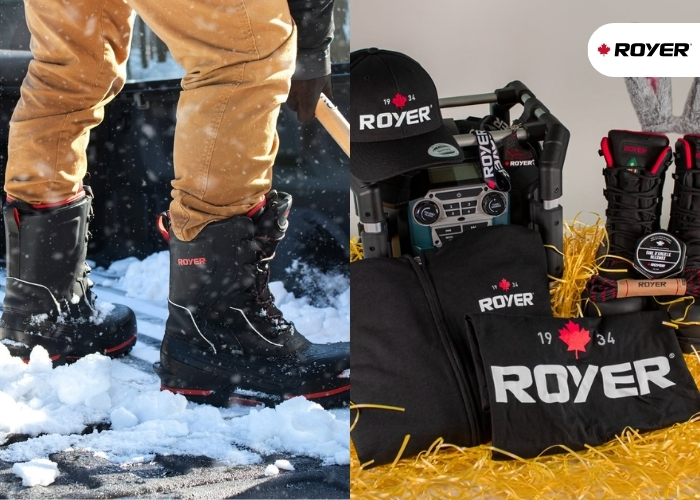
A split-screen image showing Royer work boots being worn in the snow on the left and a collection of Royer branded apparel, boots, and gear on the right.
In this article10 sections
- A Canadian Footwear Story That Began in 1934
- Manufacturing Expertise Built in Canada
- More Than 120 Steps Behind a Work Boot
- Designing Around Real Working Environments
- Putting Safety Through Rigorous Testing
- Technology Designed for Protection and Comfort
- Safety Footwear for Demanding Industries
- Respect, Rigour, and Perseverance
- Canadian Expertise With International Reach
- Protecting the People Who Keep Industries Moving
For professionals in difficult conditions, footwear is much more than a necessity. It can greatly support workplace safety, stability, comfort, and long-term performance. Royer has spent more than 90 years developing footwear based on these truths. Royer, a Canadian safety footwear business, was founded in 1934. It designs, assembles, and manufactures work boots in Canada. Today, the company sells more than 250 models in over 20 countries, serving professionals in areas where dependability and protection are critical.
A Canadian Footwear Story That Began in 1934
Royer traces its origins to Louis-Philippe Royer, who learned shoemaking and started his first business at home in 1934. Four years later, the business established its first facility in Lac-Drolet, Quebec. During World War II, difficulties in obtaining leather prompted Louis-Philippe Royer to start his own tanning facilities, expanding the company’s competence. Royer’s production methods evolved over the decades. The company introduced rubber vulcanization in 1967, marking another significant milestone in its production history. That ability to adapt while keeping footwear production in Canada remains central to Royer’s identity today.
Manufacturing Expertise Built in Canada
Royer continues to operate in Quebec. The company’s original Lac-Drolet factory is still in operation and is associated with specialist manufacturing techniques such as Royer’s XPAN dual-density rubber sole technology. In 2019, the firm opened a facility in Sherbrooke to make “Assembled in Canada” items, followed by a third plant in Magog in 2024, which will specialize in high-performance thermoplastic rubber boots. Royer claims that this hybrid production method preserves footwear knowledge and more than 120 jobs in Quebec while allowing the company to remain competitive.
Importantly, not all Royer products have the same manufacturing identification. The brand divides its footwear into three categories: Produced in Canada, assembled in Canada, and imported. Royer’s Canadian R&D and Innovation team continues to work on technical drawings, patterns, material selection, quality control, and field testing coordination across all three categories.
More Than 120 Steps Behind a Work Boot
The work required to produce a safety boot is one of the clearest examples of Royer’s manufacturing philosophy. According to the business, a pair may require up to 120 manufacturing stages. Technical drawing, shaping, patterning, cutting, assembly, mounting, fitting, and finishing are all stages of the manufacturing process for products made entirely in Canada. Throughout the process, Royer says its staff consider durability, protection, comfort, and design.
This focus on detail reflects the realities of occupational footwear. A work boot must perform consistently despite repetitive movement, long shifts, uneven surfaces, and harsh working conditions.
Designing Around Real Working Environments
Royer’s product development process starts with the people who will eventually wear its footwear. When producing safety footwear, the company says it considers the industry, employment, work environment, and the worker’s individual requirements. Its areas of competence include construction, transportation, mining, manufacturing, metallurgy, utilities, foundries, oil and gas, and military applications. Each environment carries various risks.
A construction worker may need puncture protection and traction, while someone working in metallurgy or a foundry may need extra protection against impact or harsh job conditions. Royer can create tailored solutions for various industries by designing footwear around specific applications rather than treating all workers the same.
Putting Safety Through Rigorous Testing
Protective footwear must do more than just appear durable. Its performance should be tested. Royer collaborates with independent research institutions to assess both its footwear and the materials used to create it. Slip resistance, breathability, thermal insulation, waterproofing, flexural endurance, chemical resistance, and shock absorption are among the features tested. Field testing complements laboratory evaluation. Royer claims it collaborates directly with industrial users to test footwear under real-world conditions, leveraging their expertise to improve protection, comfort, durability, and performance.
The company also runs its own CSA-approved certification lab. Royer claims its shoes are certified under the CSA Z195 Protective Footwear Standard, with performance testing conducted every 500 pairs within the same certification group to ensure consistent quality and safety.
Technology Designed for Protection and Comfort
Modern industrial footwear increasingly incorporates traditional craftsmanship with specialized materials and technologies. Royer incorporates innovations in toe protection, puncture resistance, electrical shock protection, waterproofing, abrasion resistance, cold-weather protection, metatarsal protection, and cushioning. Royer models use SHIELDTEX™, a high-performance cloth designed for automobile and motorcycle racing applications.
Royer uses the material to provide abrasion and wear resistance while remaining flexible and breathable. R-LITE™, a detachable low-density polyurethane insole, offers shock absorption, moisture management, and breathability. These developments show how today’s protective footwear goes beyond a reinforced boot. Materials, ergonomics, and specialized engineering all help to improve the product’s overall performance.
Safety Footwear for Demanding Industries
Royer promotes its products as being suitable for a wide range of situations, including traditional employment and some of the most severe industrial circumstances. Depending on the type, its safety footwear may contain features like protective toe caps, puncture-resistant soles, electrical hazard protection, and metatarsal guards. For example, modern Royer models offer CSA-certified toe protection, puncture resistance, electrical shock protection, and metatarsal protection. This specialty explains why the company’s products are used in industries where workers demand more than just everyday footwear.
Respect, Rigour, and Perseverance
Royer identifies three key organizational values: respect, rigour, and perseverance. Respect symbolizes doing the right thing for the company’s consumers, products, and the people who make them. Rigour indicates precision, discipline, and attention to detail throughout the manufacturing process. Perseverance conveys that sustaining the status quo is insufficient, and that continuous development requires tenacity and a willingness to question established techniques. These ideas are closely aligned with the company’s overall history. Royer has weathered major shifts in production, supply chains, labour norms, and footwear technology while retaining much of its knowledge in Canada.
Canadian Expertise With International Reach
Despite its deep roots in Quebec, Royer is no longer just a domestic footwear manufacturer. Its more than 250 models are sold in over 20 countries, giving the firm a global footprint while maintaining its Canadian design and production expertise. Its official LinkedIn page also underlines the company’s long-standing dedication to maintaining manufacturing activities and jobs in Canada while evolving and reinventing itself. This mix of local expertise and international reach shows how specialized Canadian manufacturing can compete globally when supported by technical know-how and distinct productiveness.
Protecting the People Who Keep Industries Moving
Royer’s business revolves around the worker. From tradespeople and construction crews to manufacturing, transportation, and industrial specialists, the company makes its goods for people who rely on their footwear every day. More than nine decades after its founding, Royer continues to combine Canadian manufacturing expertise, technical innovation, rigorous testing and worker feedback to make footwear built for challenging settings. Its story is more than preserving a manufacturing history. It is about continually adapting that legacy to meet workers’ evolving needs. Royer has remained a well-known Canadian protective footwear brand since 1934, thanks to its tenacity, craftsmanship, and innovation.
Explore Royer’s work boots and safety footwear, which are designed for protection, comfort, and durability in challenging professional conditions. Visit https://royer.com/
Your support is crucial in our mission to foster a community of innovators. CanadianSME Magazine is a valuable treasure trove of entrepreneurial knowledge. Click here to subscribe to our monthly editions for updates on Canadian businesses. Your role in staying updated is integral to our shared mission. Follow our handle @canadian_sme on X to remain updated on all business trends and developments.
With an aim to contribute to the development of Canada’s Small and Medium Enterprises (SME’s), Cmarketing Inc is a potential marketing agency and a boutique business management company progressing rapidly in its scope. By acknowledging a firm reliance of the Canadian economy over its SMEs, the agency has resolved to launch a magazine, the pure focus of which will be the furtherance of Canadian SMEs, and to assist their progress with the scheduled token of enlightenment via the magazine’s pertinent content.
View profile →